Ecommerce Website Development Cost in Nepal 2026: Complete Guide
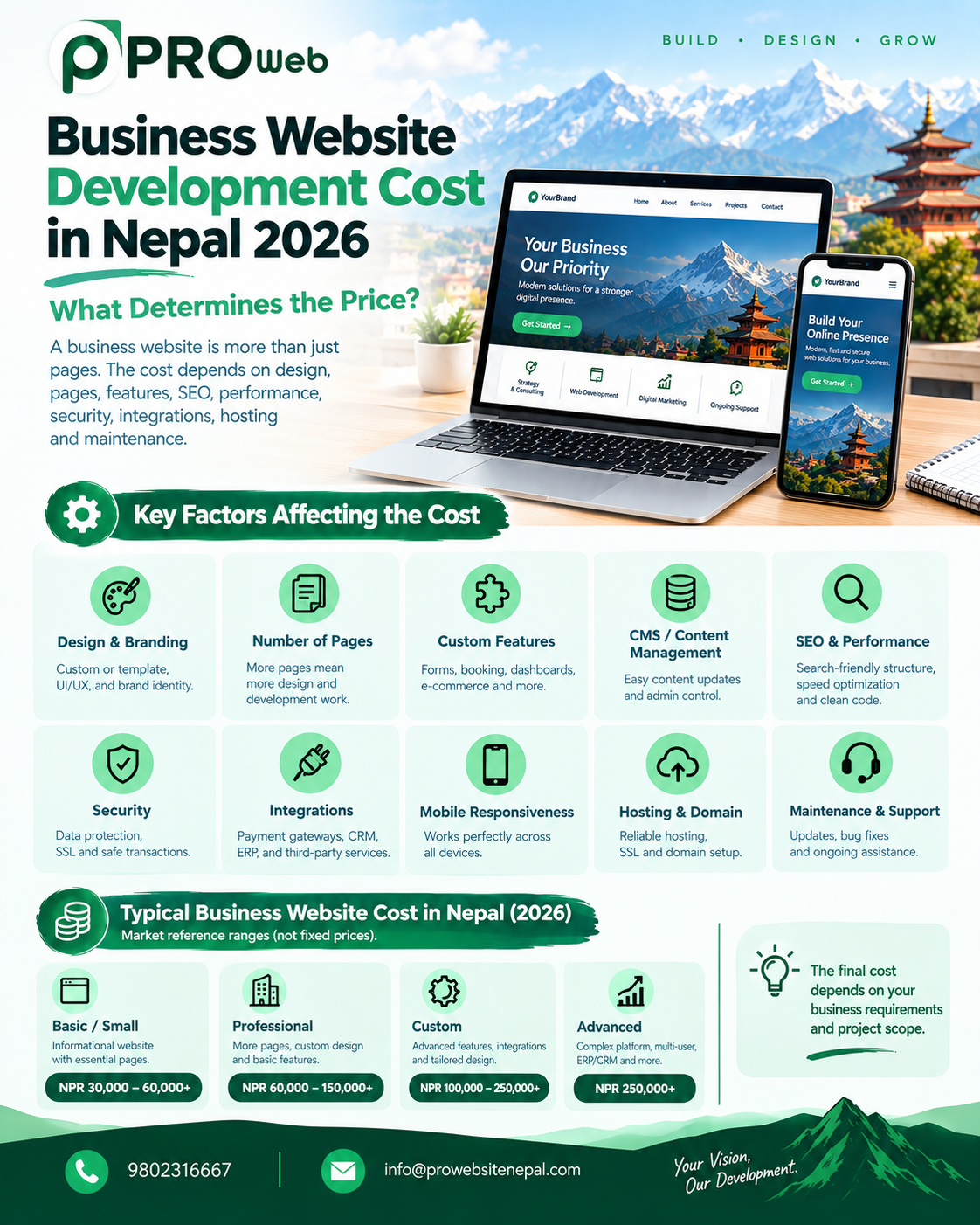
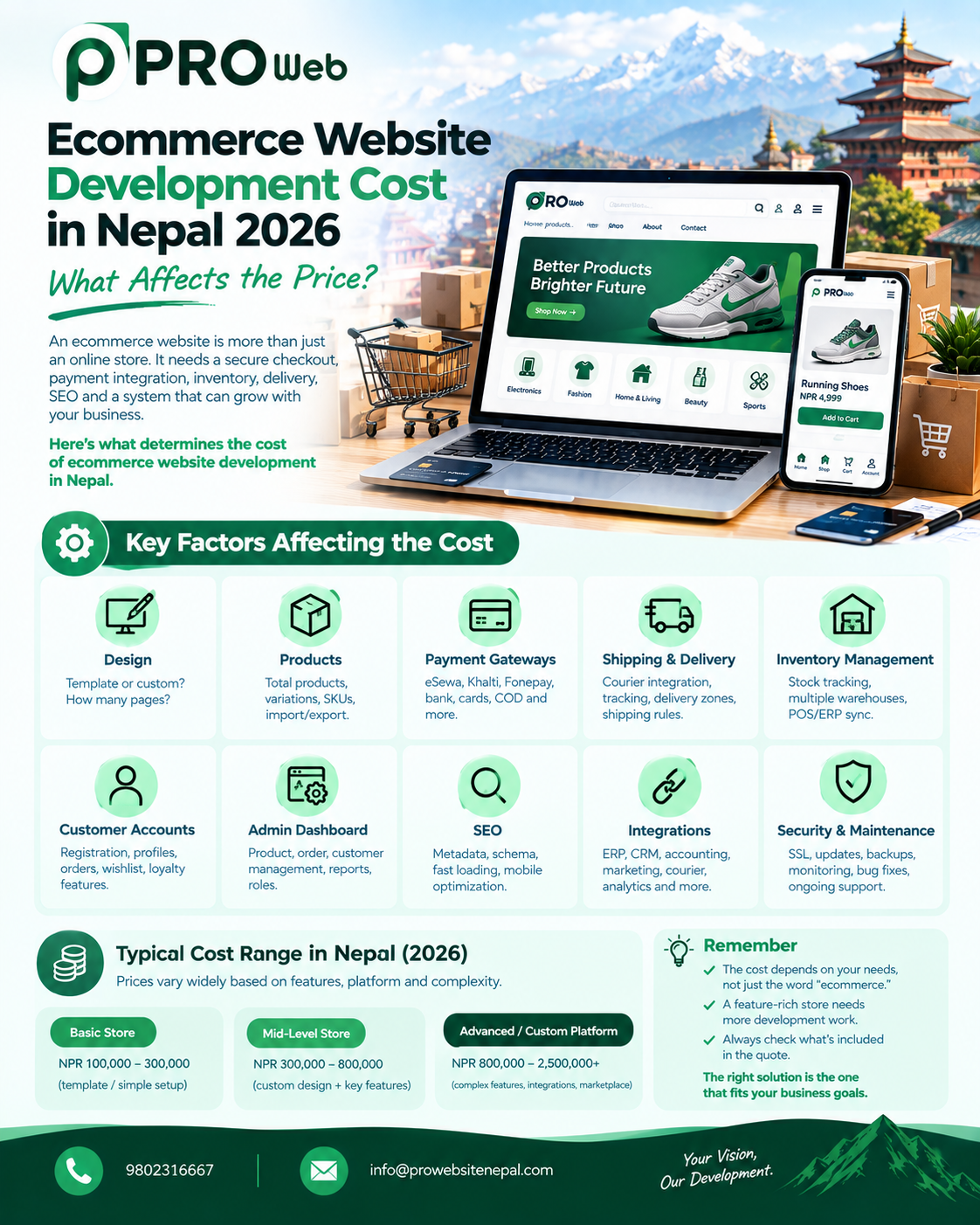
Launching an ecommerce website in Nepal is no longer simply about putting products online. A modern online store needs a reliable product catalog, mobile-friendly design, secure checkout, payment integration, order management, delivery workflows, search functionality, SEO, performance optimization, and a system that can grow as the business grows.
Because of this, there is no single fixed cost for ecommerce website development in Nepal.
A small online store with a limited product catalog can have very different development requirements from a large ecommerce platform with thousands of products, multiple payment methods, inventory synchronization, customer accounts, advanced filtering, courier integrations, and custom business logic.
Current 2026 Nepal market estimates show a wide spread in ecommerce development pricing, with reported costs varying substantially depending on platform, design, integrations, product volume, and complexity.
This guide explains the major factors that determine ecommerce website development cost in Nepal and what businesses should consider before requesting a development quote.
What Determines Ecommerce Website Development Cost in Nepal?
The most important point to understand is that the number of features matters more than the word "ecommerce."
Two businesses may both ask for an ecommerce website, but their requirements can be completely different.
For example:
Store A
30 products
Basic product categories
Product images
Shopping cart
Cash on delivery
Basic payment integration
Simple checkout
Basic admin management
Store B
5,000+ products
Product variations
Advanced filtering
Multiple payment gateways
Inventory synchronization
Customer accounts
Vendor accounts
Courier API
Automated invoices
Discount engine
Multiple warehouses
ERP integration
Advanced analytics
Both are ecommerce websites.
But they are not the same development project.
That difference is why ecommerce development pricing in Nepal can vary significantly.
1. Website Design
Design is one of the first factors that affects development cost.
An ecommerce website needs more than an attractive homepage.
Important pages and interfaces can include:
Homepage
Product listing
Product detail
Category pages
Search results
Shopping cart
Checkout
Customer login
Customer registration
Customer dashboard
Wishlist
Order tracking
About page
Contact page
FAQ
Privacy policy
Terms and conditions
A template-based store can reduce design and development time.
A completely custom ecommerce interface requires more planning, UI design, responsive layouts, component development, and testing.
Custom design may include:
Custom homepage
Custom product cards
Custom category layouts
Custom checkout
Mobile-first interface
Brand-specific colors
Custom typography
Custom icons
Interactive elements
Conversion-focused layouts
The more unique the design requirements, the more development work is generally required.
2. Number of Products
The number of products can affect the complexity of an ecommerce project.
A store with a small catalog may have relatively simple product management.
A larger catalog may require:
Bulk product import
CSV import/export
Product variations
SKU management
Inventory tracking
Bulk price updates
Bulk image management
Advanced categories
Product attributes
Search optimization
Filtering
For example, clothing stores may need:
Product
   ↓
Size
   ↓
Color
   ↓
Stock
   ↓
SKU
A simple product may only require:
Product
   ↓
Price
   ↓
Stock
The more complex the product structure, the more sophisticated the ecommerce system needs to become.
3. Ecommerce Platform
The technology used to build the store has a major influence on the project.
Common approaches include:
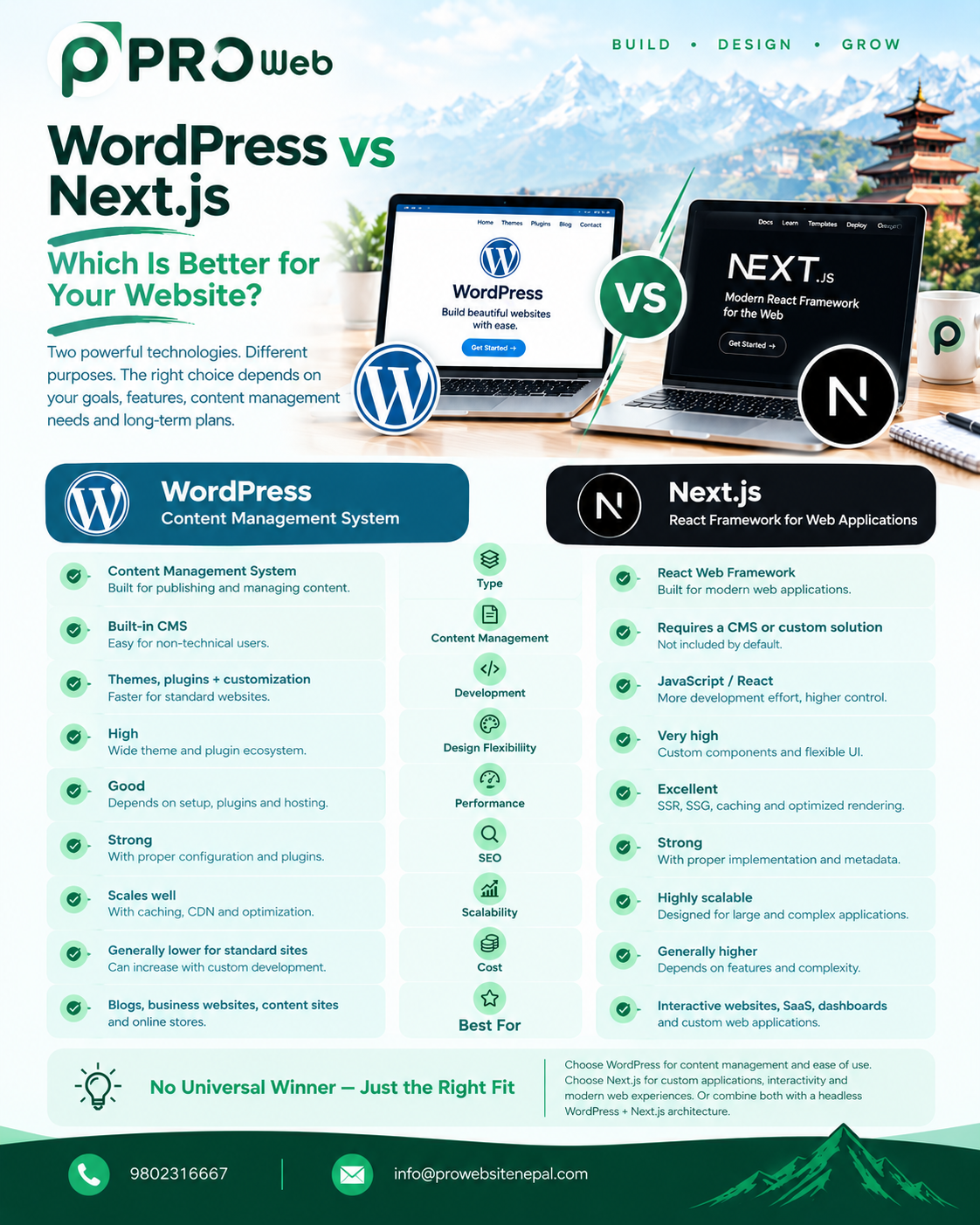
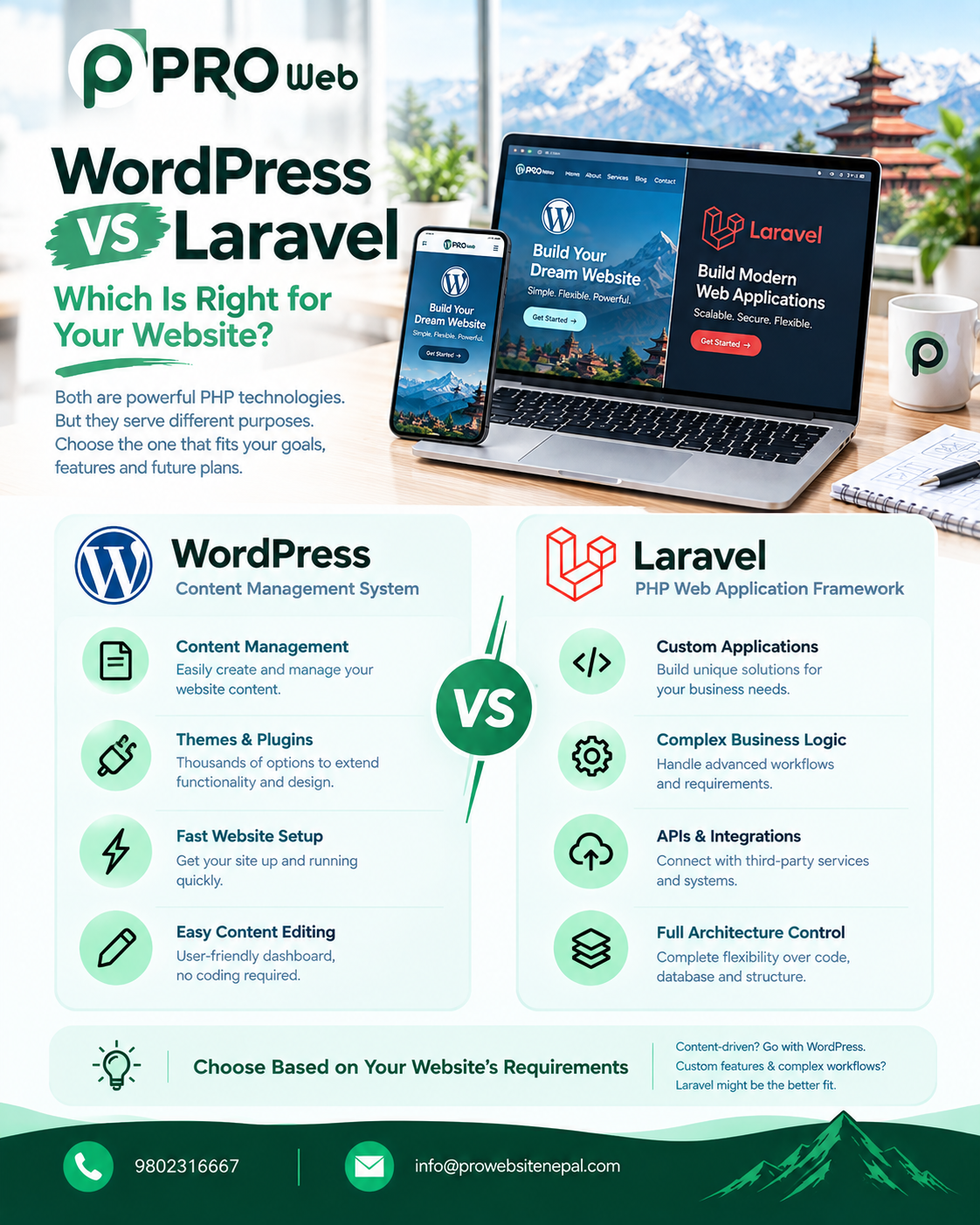
WordPress + WooCommerce
WooCommerce provides ecommerce functionality within WordPress.
It can be useful for businesses that want:
Product management
Content management
Plugins
Themes
Existing ecommerce functionality
Faster development
Current Nepal market guides commonly place WooCommerce among the lower-cost routes for launching a conventional ecommerce store, although the actual cost varies significantly with customization and integrations.
Shopify
Shopify provides a hosted ecommerce platform.
Businesses do not need to manage the same level of server infrastructure themselves, but ongoing subscription and platform-related costs need to be considered.
Custom Development
A custom ecommerce application can be built using technologies such as:
Laravel
Next.js
React
Node.js
PHP
Other backend technologies
Custom development can provide greater control over business logic, architecture, integrations, and user workflows, but usually requires more development work.
Some current Nepal market estimates place custom ecommerce projects substantially above basic WooCommerce stores because of the additional application development involved.
4. Payment Gateway Integration
Payment integration is an important part of ecommerce development in Nepal.
A local ecommerce website may need to support payment options such as:
eSewa
Khalti
Fonepay
ConnectIPS
Bank payments
Cash on Delivery
The exact combination depends on the business.
Payment integration involves more than simply displaying a payment button.
The system may need to handle:
Customer
   ↓
Checkout
   ↓
Payment Gateway
   ↓
Payment Verification
   ↓
Order Confirmation
   ↓
Database
   ↓
Admin
The system needs to correctly determine whether the transaction succeeded, failed, or is still pending.
Current Nepal ecommerce development sources commonly identify eSewa, Khalti and Fonepay among the local payment options businesses consider.
5. Cash on Delivery
Cash on Delivery remains an important consideration for ecommerce businesses serving Nepal.
A website supporting COD may need to collect:
Customer name
Phone number
Address
City
Delivery location
Order information
The store may also need mechanisms for:
COD verification
Order confirmation
Delivery status
Failed delivery tracking
Returns
Therefore, COD should be treated as part of the ecommerce workflow rather than simply another payment button.
6. Shipping and Courier Integration
Delivery is another major factor in ecommerce development cost.
A basic store may simply allow an administrator to manually enter delivery information.
A more advanced system may integrate with courier or logistics services.
For example:
Order Placed
      ↓
Payment Confirmed
      ↓
Courier API
      ↓
Shipment Created
      ↓
Tracking Number
      ↓
Customer Notification
Advanced ecommerce systems may also need:
Delivery zones
Delivery charges
Free shipping thresholds
Same-day delivery
City-based pricing
Weight-based shipping
Order tracking
Return management
These features increase development complexity.
7. Product Search and Filtering
A small store may only need a basic search box.
A larger ecommerce website may need:
Keyword search
Category filtering
Price filtering
Brand filtering
Size filtering
Color filtering
Rating filtering
Availability filtering
Sorting
Search suggestions
For example:
Search: Running Shoes

Filters:
✓ Brand
✓ Size
✓ Color
✓ Price
✓ Availability
✓ Rating
Advanced filtering becomes especially important when a store has hundreds or thousands of products.
8. Product Variations
Product variations can significantly affect ecommerce development.
Consider a clothing product:
T-Shirt
Colors:
Black
White
Blue

Sizes:
S
M
L
XL
XXL
The store may need to maintain separate:
Prices
SKUs
Stock quantities
Images
Availability
for different combinations.
This requires more sophisticated product management than a simple product listing.
9. Inventory Management
Inventory functionality can range from extremely simple to highly advanced.
Basic inventory
Product
Price
Stock Quantity
Advanced inventory
Product
   ↓
Warehouse A
   ↓
Warehouse B
   ↓
Warehouse C
   ↓
Stock Transfers
   ↓
Low Stock Alerts
Businesses with physical stores may also need synchronization between their physical inventory and ecommerce inventory.
This can significantly increase development requirements.
10. Customer Accounts
A basic ecommerce store may allow customers to purchase as guests.
A more advanced store may provide customer accounts.
Customers may be able to:
Register
Login
Edit profiles
Save addresses
View orders
Track orders
Download invoices
Create wishlists
Save products
Manage payment information
A custom customer dashboard requires additional development and testing.
11. Admin Dashboard
The ecommerce customer interface is only half of the system.
The business also needs an administrative interface.
An ecommerce admin panel may contain:
Dashboard
├── Products
├── Categories
├── Orders
├── Customers
├── Inventory
├── Payments
├── Coupons
├── Reviews
├── Shipping
├── Reports
└── Settings
A basic store can use an existing administration system.
A custom ecommerce application may require a completely customized dashboard.
The complexity of this dashboard can significantly affect development time.
12. Discounts and Coupon System
Businesses often need promotional functionality.
For example:
Percentage discounts
Fixed discounts
Coupon codes
First-order discounts
Category discounts
Product-specific discounts
Minimum-order discounts
Free shipping
Limited-time offers
A basic coupon system is relatively straightforward.
A sophisticated promotion engine can become much more complex.
For example:
10% OFF

IF:
Customer = New
AND
Order > NPR 5,000
AND
Category = Electronics
AND
Date = Dashain Campaign
The more complex the rules, the more development is required.
13. SEO
SEO should be considered during ecommerce development rather than added after the website is finished.
An ecommerce website may need:
SEO-friendly URLs
Product metadata
Category metadata
Canonical URLs
XML sitemap
Structured data
Product schema
Breadcrumb schema
Optimized images
Internal linking
Search-friendly category structures
Fast-loading pages
For example:
Bad URL:

/product?id=8237

Better:

/running-shoes/nike-air-max
The website architecture should also prevent unnecessary duplicate pages from being indexed.
SEO requirements can therefore influence the development architecture.
14. Mobile Optimization
A large percentage of ecommerce activity can happen through mobile devices.
A modern ecommerce website should therefore be designed around mobile users rather than simply shrinking the desktop version.
Important mobile elements include:
Touch-friendly buttons
Mobile navigation
Fast product pages
Optimized images
Easy checkout
Mobile payment experience
Sticky cart controls
Responsive product galleries
Mobile optimization can require additional design and testing.
15. Website Performance
Ecommerce websites often contain many:
Product images
JavaScript components
Filters
Tracking scripts
Payment integrations
Third-party services
Without proper optimization, these can negatively affect performance.
Performance optimization may involve:
Image compression
WebP/AVIF images
Lazy loading
Caching
CDN
Database optimization
Code optimization
Server configuration
Query optimization
For custom ecommerce systems, architecture and caching strategy can become particularly important as traffic and product volume grow.
16. Security
An ecommerce website handles important information.
Depending on its architecture, this can include:
Customer accounts
Contact information
Addresses
Orders
Payment information
Authentication credentials
Security should therefore be considered from the beginning.
Important areas include:
HTTPS
Secure authentication
Input validation
Authorization
Database security
Secure API communication
Dependency updates
Backup systems
Server security
Fraud prevention
A payment gateway should handle sensitive payment processing according to its own security requirements rather than having a website unnecessarily store sensitive payment credentials.
17. Third-Party Integrations
Integrations can significantly increase ecommerce development requirements.
A business may want to connect the store with:
Accounting software
CRM
ERP
Inventory software
Courier systems
Payment gateways
SMS services
Email platforms
Analytics
Marketing platforms
POS systems
For example:
Ecommerce Website
       ↓
      API
 ┌─────┼─────┐
 ↓     ↓     ↓
ERP   CRM  Courier
Each integration requires development, testing, authentication, error handling, and maintenance.
18. Multi-Vendor Ecommerce
A multi-vendor marketplace is significantly more complex than a normal online store.
Instead of:
Admin
  ↓
Products
  ↓
Customers
you have:
Admin
  ↓
Vendors
  ↓
Products
  ↓
Customers
  ↓
Orders
The system may need:
Vendor registration
Vendor verification
Vendor dashboard
Product approval
Commission calculation
Vendor payouts
Vendor orders
Vendor reports
Reviews
Dispute management
This changes the project from a standard online store into a marketplace platform.
19. B2B Ecommerce
B2B ecommerce can require additional functionality.
For example:
Wholesale pricing
Minimum order quantity
Customer-specific pricing
Credit accounts
Purchase orders
Business accounts
Sales representatives
Bulk ordering
Tax/VAT handling
Approval workflows
A B2B ecommerce platform therefore needs different business logic from a standard consumer store.
20. Hosting and Infrastructure
Development cost is not the same as operating cost.
An ecommerce website may require:
Domain
Hosting
SSL
Backups
CDN
Email
Monitoring
Maintenance
Hosting requirements depend on:
Traffic
Product count
Database size
Images
Server-side processing
Number of concurrent users
A small store may work with relatively modest hosting.
A large ecommerce application may require VPS or cloud infrastructure.
21. Maintenance Cost
Launching the website is only the beginning.
Ongoing maintenance can include:
Security updates
Software updates
Bug fixes
Backups
Performance monitoring
Server maintenance
Plugin updates
Payment gateway changes
API changes
Content updates
Current Nepal market guides also identify hosting, maintenance, plugin licenses, and payment processing as recurring ecommerce expenses beyond the initial development project.
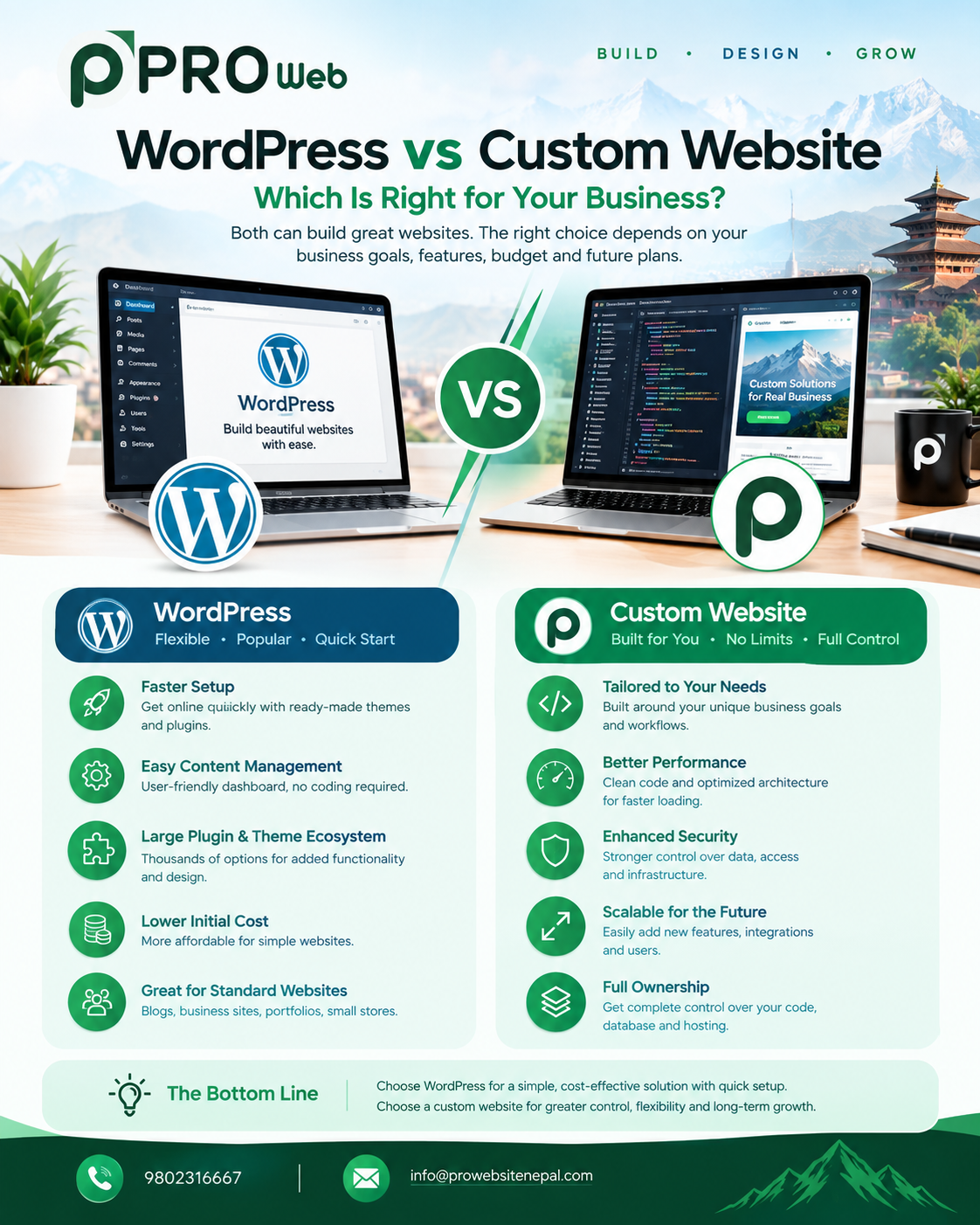
22. Custom vs Template-Based Ecommerce Website
One of the most important cost factors is whether the store uses an existing template or a custom design.
Template-Based Store
A template can provide:
Existing layout
Existing product pages
Existing navigation
Existing styling
Faster setup
This can reduce initial development effort.
Custom Ecommerce Website
A custom website can provide:
Unique UI
Custom product pages
Custom checkout
Custom business logic
Custom integrations
Custom admin dashboard
Custom database architecture
Performance optimization
This generally requires more design and development work.
The choice should depend on the business requirements rather than simply choosing the cheapest initial option.
Ecommerce Website Development Cost Factors in Nepal
Instead of asking only:
"How much does an ecommerce website cost?"
businesses should ask:
Design
Is the design template-based or custom?
How many unique pages are required?
Is mobile-first design included?
Products
How many products?
Are there product variations?
Are there thousands of SKUs?
Payments
Is COD required?
eSewa?
Khalti?
Fonepay?
Bank payments?
International payments?
Shipping
Manual delivery?
Multiple delivery zones?
Courier integration?
Live tracking?
Inventory
Basic stock management?
Multiple warehouses?
POS synchronization?
ERP integration?
Customers
Guest checkout?
Customer accounts?
Wishlist?
Loyalty system?
Admin
Basic dashboard?
Advanced reporting?
Multiple admin roles?
Business Model
Single vendor?
Multi-vendor?
B2B?
Subscription?
Marketplace?
SEO
Product schema?
Category optimization?
Technical SEO?
Content management?
These questions give a much more accurate understanding of the project than a generic ecommerce price.
Typical Ecommerce Development Levels
Rather than treating every ecommerce website as the same, projects can be divided by complexity.
Basic Ecommerce Website
Usually includes:
Responsive design
Product catalog
Categories
Product pages
Shopping cart
Checkout
COD
Basic payment integration
Basic admin management
Basic SEO
Suitable for businesses starting online sales with a relatively simple catalog.
Mid-Level Ecommerce Website
May include:
Custom UI
Advanced product filtering
Product variations
Multiple payment options
Shipping rules
Customer accounts
Wishlist
Coupons
Reviews
Inventory management
Analytics
SEO optimization
Suitable for growing ecommerce businesses.
Advanced Ecommerce Platform
May include:
Custom architecture
Large product catalog
Advanced search
Multiple warehouses
ERP integration
CRM integration
Multiple payment gateways
Courier APIs
Advanced reporting
Role-based administration
Custom checkout
Automated notifications
Custom business workflows
This type of project requires substantially more planning and engineering.
Marketplace / Multi-Vendor Platform
May include:
Vendor registration
Vendor dashboard
Product management
Vendor verification
Commission system
Vendor payouts
Customer accounts
Order management
Reviews
Dispute management
Advanced reporting
This is closer to building a complete ecommerce platform than a conventional online store.
What Should Be Included in an Ecommerce Development Quote?
Before accepting a quote, businesses should check exactly what is included.
A professional quotation should clearly explain:
Design
UI/UX
Responsive design
Number of pages
Development
Frontend
Backend
Database
Admin panel
Ecommerce
Products
Categories
Cart
Checkout
Orders
Payments
Which gateways?
Integration included?
Transaction charges included?
Shipping
Delivery rules?
Courier integration?
SEO
Technical SEO?
Metadata?
Sitemap?
Schema?
Content
Product uploading?
Product descriptions?
Images?
Infrastructure
Hosting?
Domain?
SSL?
Backup?
Support
Bug fixing?
Maintenance?
Updates?
Training?
A low initial quote can become significantly more expensive if important features are excluded from the original scope.
Why Ecommerce Website Prices Differ So Much in Nepal
Search results for ecommerce development in Nepal show widely different estimates, from relatively inexpensive basic stores to substantially more expensive custom platforms. This is largely because different providers are pricing different levels of scope rather than exactly the same product.
For example, one provider may offer:
Theme
+
WooCommerce
+
Basic Plugins
while another may offer:
Custom UI
+
Custom Backend
+
Payment APIs
+
Courier Integration
+
Inventory System
+
Custom Admin
+
SEO
+
Performance Optimization
These should not be compared as if they were identical projects.
Custom Ecommerce Development in Nepal
For businesses with unique requirements, custom development can provide greater control over:
Architecture
Database
Business logic
User roles
APIs
Checkout
Inventory
Integrations
Performance
Security
Scalability
A custom ecommerce system may use technologies such as Laravel, Next.js, React, or other frameworks depending on the architecture.
Custom development is particularly relevant when the business needs functionality that does not fit easily into an existing ecommerce platform.
Ecommerce SEO and Development Should Work Together
SEO should not be treated as something added after development.
The architecture itself affects SEO.
For example:
Product
   ↓
Category
   ↓
URL
   ↓
Metadata
   ↓
Structured Data
   ↓
Search Engine
An ecommerce website should be designed so that search engines can efficiently discover and understand important products and categories.
Technical SEO can include:
Clean URLs
XML sitemap
Canonical URLs
Structured data
Fast pages
Mobile optimization
Internal linking
Optimized images
Crawl management
How Professional Website Nepal Approaches Ecommerce Development
At Professional Website Nepal, ecommerce development can begin with the business requirements rather than starting with a fixed template or technology.
The development process can consider:
Product structure
Customer journey
Payment requirements
Delivery workflow
Inventory
Business logic
SEO
Performance
Security
Scalability
Future integrations
For businesses requiring a straightforward online store, an appropriate ecommerce platform can provide an efficient starting point.
For businesses with specialized requirements, custom development can provide greater control over the architecture and functionality.
The goal is to build an ecommerce website around the actual business rather than forcing every business into the same structure.
Questions to Ask Before Building an Ecommerce Website
Before starting development, businesses should answer:
What are you selling?
Physical products, digital products, services, subscriptions, or multiple categories?
How many products will you have?
10 products and 10,000 products can require very different architectures.
Where will you deliver?
Kathmandu Valley, throughout Nepal, or internationally?
How will customers pay?
COD, eSewa, Khalti, Fonepay, bank transfer, cards, or other methods?
How will inventory be managed?
Manually, through an ecommerce dashboard, POS, ERP, or another system?
Do you need customer accounts?
If yes, what should customers be able to do?
Do you need integrations?
Consider:
Payment gateways
Couriers
ERP
CRM
Accounting
POS
Marketing platforms
Do you need a marketplace?
If multiple businesses will sell through the platform, the architecture will be significantly more complex.
What are your SEO goals?
Decide whether organic search traffic is a major acquisition channel from the beginning.
Final Thoughts
The cost of ecommerce website development in Nepal depends on what the website needs to do, not simply on the fact that it is an ecommerce website.
The major factors include:
Design
Product count
Product variations
Platform
Payment gateways
Shipping
Inventory
Customer accounts
Admin functionality
SEO
Performance
Security
Integrations
Custom business logic
Scalability
Maintenance
A basic online store and a large ecommerce marketplace may both be called "ecommerce websites," but they can require completely different levels of development.
For this reason, businesses should look beyond the headline price and examine exactly what is included in the development scope.
A well-planned ecommerce website should not only allow customers to purchase products. It should provide a reliable foundation for managing products, orders, customers, payments, delivery, SEO, and future growth.
For businesses in Nepal, the best development approach is therefore one that matches the store's products, customers, operations, budget, and long-term business goals.