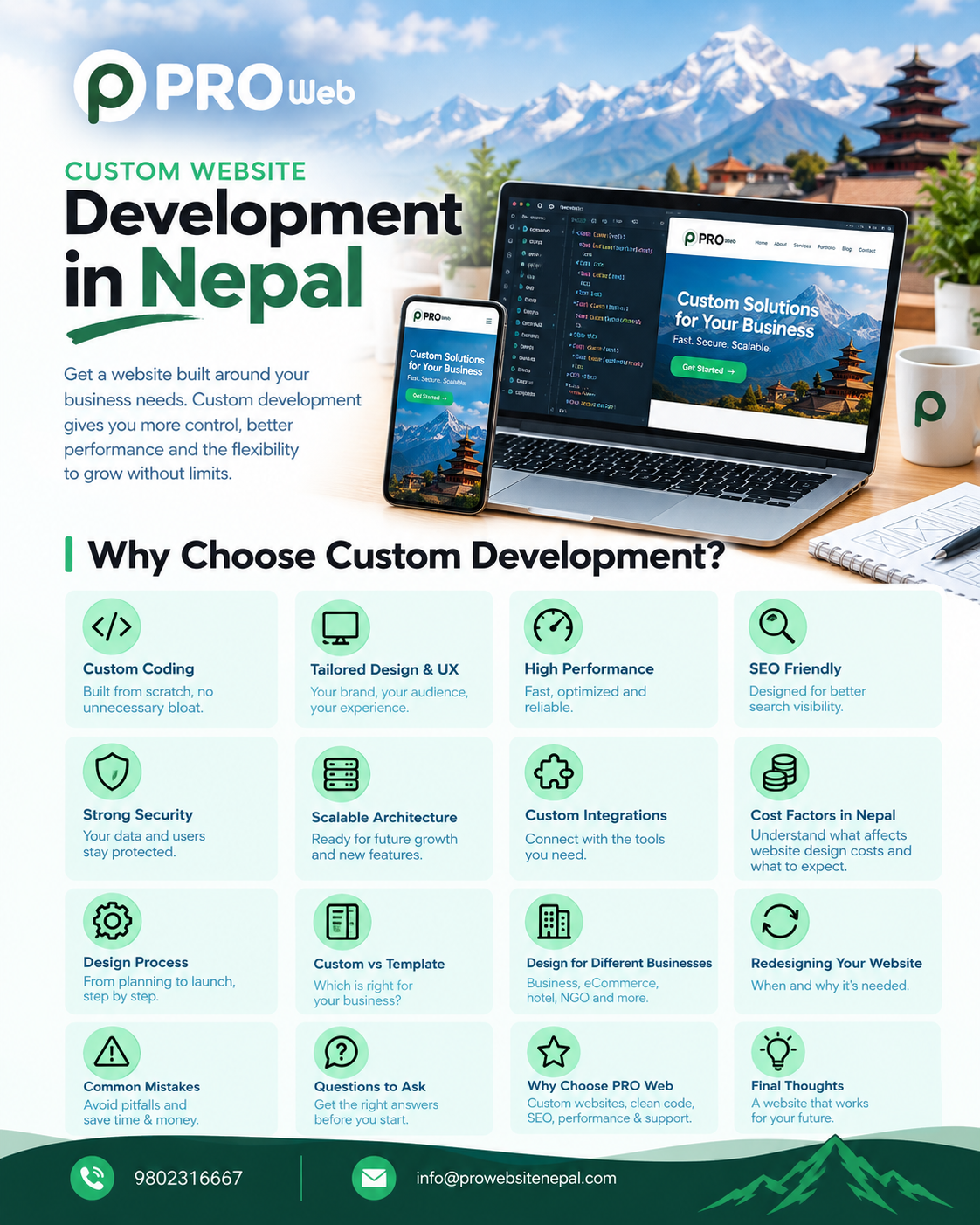
Custom Website Development in Nepal
A website is no longer simply an online brochure for a business. For many companies, it is a major part of how customers discover services, evaluate a brand, submit inquiries, make purchases, and interact with the business.
As businesses in Nepal become more dependent on digital channels, the need for websites that are fast, secure, flexible, and built around specific business requirements is increasing. Custom website development provides an alternative to relying entirely on pre-built themes, generic templates, and unnecessary features.
A custom website is developed around the business itself. Its design, functionality, database structure, content management system, integrations, and technical architecture can all be planned according to the organization's requirements.
Professional Website Nepal focuses on custom website development using clean core coding, performance-focused development, responsive interfaces, and SEO-friendly architecture. The goal is to create websites that provide businesses with greater control over how their digital platform works and evolves.
What Is Custom Website Development?
Custom website development is the process of designing and developing a website specifically for a particular business, organization, product, or project.
Instead of starting with a generic template and modifying existing components, developers can create the website architecture, functionality, and user experience according to the project's requirements.
This can include:
Custom UI and UX
Custom frontend development
Custom backend development
Database architecture
Custom CMS
User authentication
Business dashboards
APIs and third-party integrations
Payment gateways
Search functionality
E-commerce functionality
Advanced forms
Booking systems
Customer portals
Admin panels
SEO-friendly structures
Performance optimization
Security features
The important difference is that the website is developed around the business requirements rather than forcing the business to adapt to the limitations of a pre-built website.
Why Businesses in Nepal Are Considering Custom Websites
A basic website may be sufficient for some businesses. However, growing businesses can eventually require functionality that a standard template cannot provide efficiently.
A business might need a customized customer registration system, an internal dashboard, a product management system, an online booking platform, a specialized search system, payment integration, or a website that connects with another application.
Custom development allows these requirements to become part of the website's architecture.
It can also provide greater control over the site's code, structure, functionality, performance, and future development.
Custom Website Development vs Template-Based Websites
Template-based websites can provide a quick starting point because many design components and features are already available.
Custom development takes a different approach.
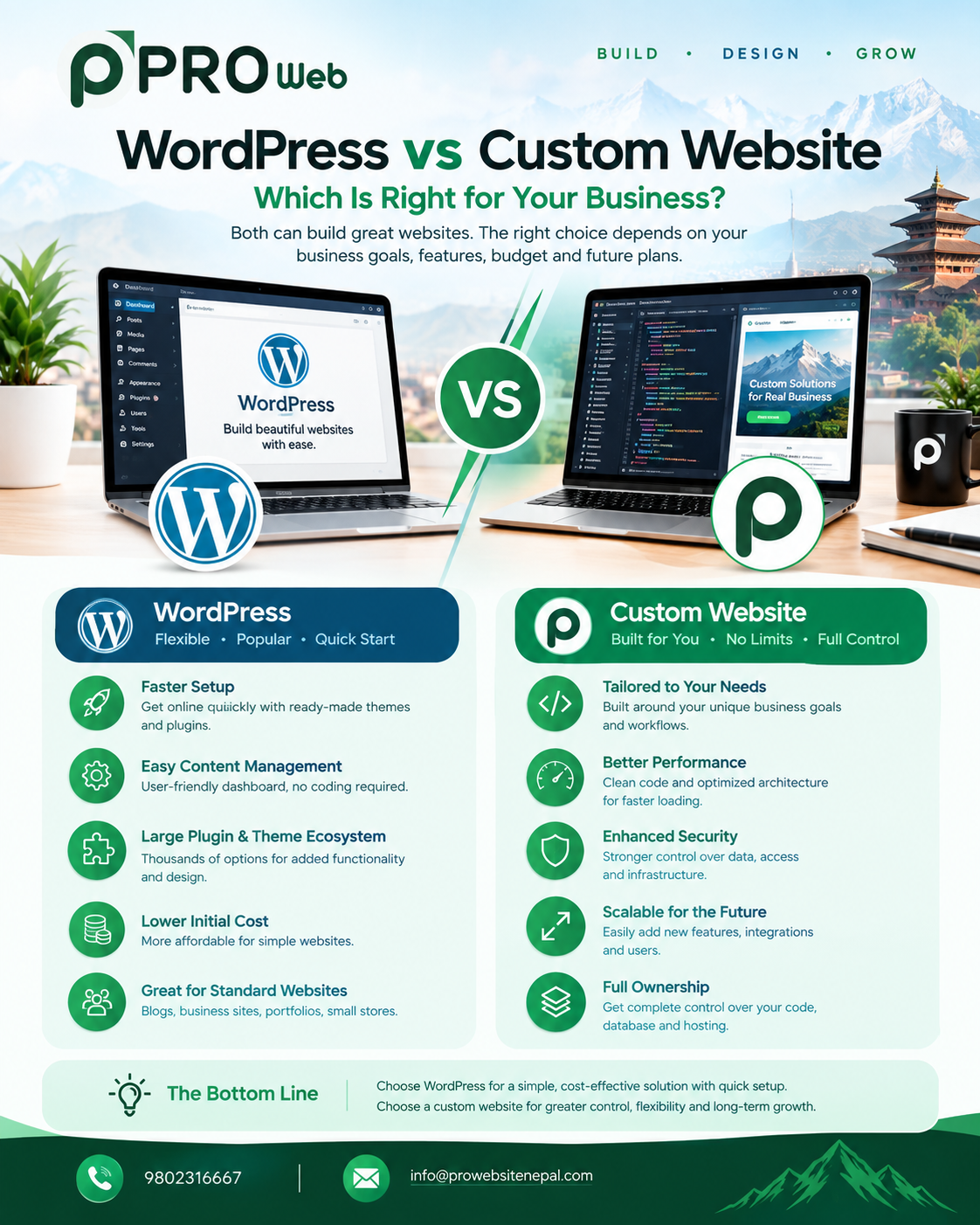
Area | Template-Based Website | Custom Website |
|---|---|---|
Design | Based on existing themes | Designed around the brand |
Functionality | Depends on available features | Built around requirements |
Code | May contain unused features | Can be kept specific to the project |
Scalability | Depends on platform/theme | Planned around future requirements |
Integrations | Often plugin-dependent | Can be developed specifically |
SEO Structure | Depends on implementation | Architecture can be planned for SEO |
Performance | Depends on theme and plugins | Performance can be considered from the beginning |
Ownership | Depends on platform/setup | Greater control over code and infrastructure |
Maintenance | Often involves themes/plugins | Can be maintained according to the custom architecture |
Neither approach is automatically suitable for every business. The appropriate solution depends on the website's purpose, functionality, budget, content management requirements, and long-term plans.
What Makes a Website Truly Custom?
Simply changing colors, images, fonts, and a logo does not necessarily make a website custom.
A genuinely custom website can involve custom decisions across multiple technical layers.
Custom Design
The interface is designed according to the company's brand, audience, content, and business objectives.
Custom Frontend
The visible portion of the website is developed specifically for the project rather than relying entirely on pre-existing page structures.
Custom Backend
Business logic can be created specifically for the required operations.
Custom Database
Data structures can be organized around the actual information the business needs to store and manage.
Custom CMS
A content management system can be developed around the company's workflow so administrators can manage relevant content without unnecessary controls.
Custom Integrations
External services such as payment systems, CRMs, APIs, analytics platforms, email services, and other applications can be integrated according to project requirements.
The Role of Clean Code in Custom Website Development
Code quality has a direct impact on how easily a website can be maintained and expanded.
A clean development approach focuses on organizing code logically, avoiding unnecessary dependencies, maintaining consistent structures, and keeping the application understandable for future developers.
Professional Website Nepal emphasizes clean core coding as part of its custom development approach. Its website describes its process as combining custom CMS development, planning, responsive design, core development, on-page SEO, and testing.
Clean code can make it easier to:
Fix problems
Add new functionality
Update existing features
Identify security issues
Improve performance
Maintain the website over time
Transfer the project to another development team
Custom Website Development and Performance
Website performance matters because users do not want to wait for pages to load.
Performance depends on many factors, including:
HTML structure
CSS
JavaScript
Images
Fonts
Server response
Database queries
Caching
Hosting infrastructure
Third-party scripts
API requests
Custom development provides more control over these components.
Instead of automatically loading every feature offered by a theme or page builder, developers can structure the website around the functionality that is actually required.
Current Nepal-focused web development providers also emphasize mobile performance, Core Web Vitals, and lightweight implementation as important considerations for custom websites.
Custom Website Development and SEO
SEO should not be treated as something that is added only after the website has been completed.
Technical decisions made during development can affect how search engines understand and access a website.
A custom website can be structured with SEO considerations such as:
Search-friendly URLs
Semantic HTML
Proper heading hierarchy
Metadata
XML sitemaps
Robots directives
Canonical URLs
Structured data
Internal linking
Mobile responsiveness
Page performance
Image optimization
Crawlable content
Proper redirects
Professional Website Nepal states that its custom websites are developed with SEO practices incorporated from the beginning, including clean code, mobile responsiveness, metadata, and structured data.
Custom development does not automatically make a website rank on Google. SEO still requires high-quality content, authority, technical maintenance, search intent alignment, and ongoing optimization.
Mobile-First Custom Website Development
A large portion of website browsing happens through smartphones, making mobile usability an important development consideration.
A custom website should therefore be designed and tested across different screen sizes.
Mobile-first development can consider:
Touch-friendly buttons
Readable typography
Responsive layouts
Optimized images
Lightweight scripts
Fast loading
Mobile navigation
Short and usable forms
Proper spacing
Accessible interactive elements
A website that works well on a desktop but becomes difficult to use on a phone is not providing a complete user experience.
Custom CMS Development
A CMS allows a business to manage website content without modifying the underlying code every time.
For example, an organization might need administrators to manage:
Blog posts
Services
Products
Team members
Testimonials
Categories
Images
Pages
Frequently asked questions
Job vacancies
Events
A custom CMS can be designed around exactly these requirements.
Instead of giving administrators hundreds of controls they will never use, a custom dashboard can focus on the tasks that matter to the organization.
This can make the administration experience simpler while also giving developers greater control over the underlying system.
Custom Admin Panels
Some businesses require more than a content management system.
A custom admin panel can provide functionality such as:
User management
Order management
Product management
Customer records
Reports
Analytics
Notifications
Inventory
Role-based permissions
Content management
Payment records
For businesses with complex internal processes, the website can become more than a marketing platform. It can become part of the company's operational system.
APIs and Custom Website Development
Modern websites often need to communicate with other systems.
APIs allow different software systems to exchange information.
For example, a website might connect with:
Payment gateways
CRM systems
Email platforms
Accounting software
Mobile applications
Inventory systems
Shipping services
Authentication providers
Government or third-party services
Custom development gives developers more flexibility when designing these integrations around the actual workflow of the business.
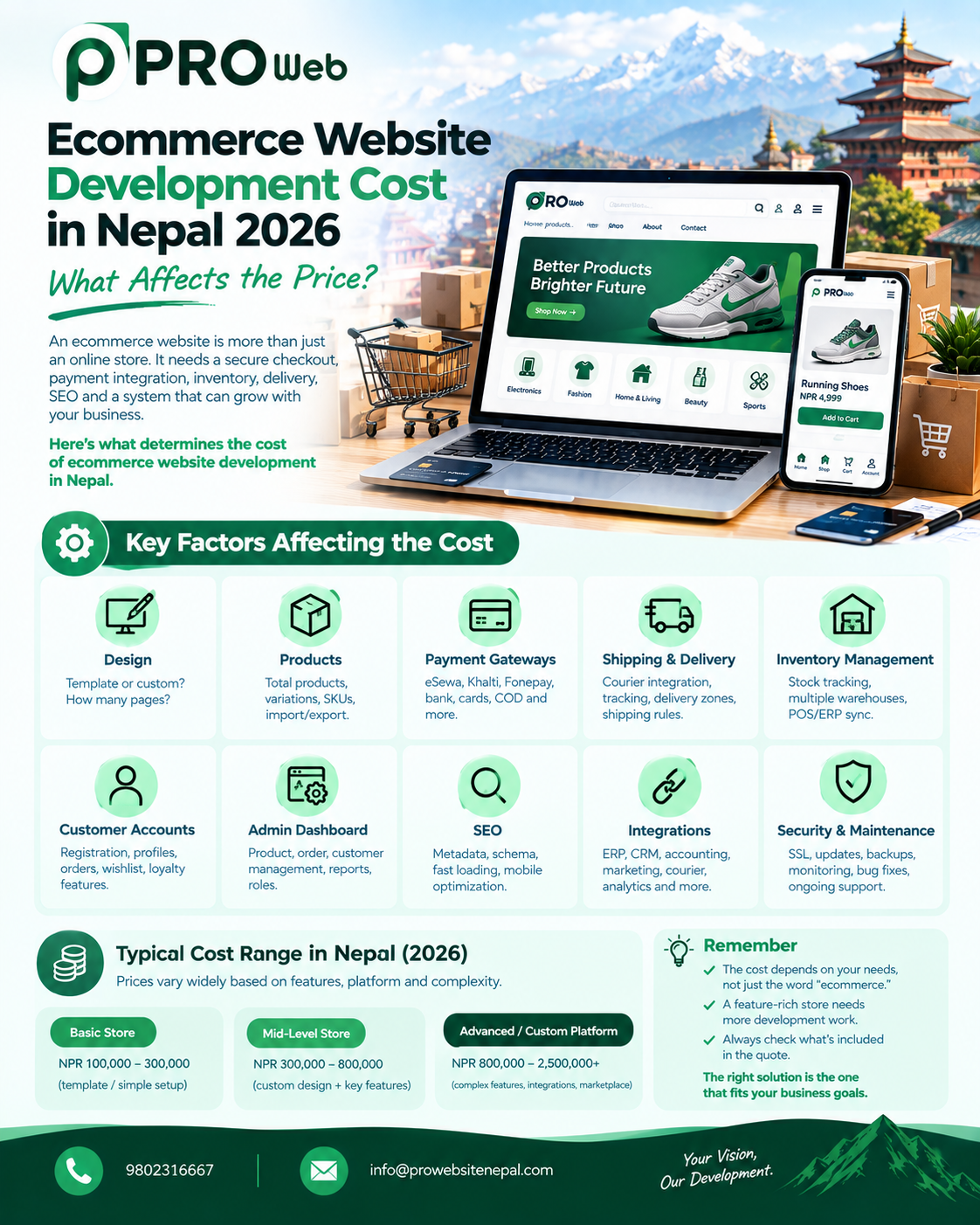
E-Commerce Website Development in Nepal
Businesses selling products online may require functionality beyond displaying product information.
A custom e-commerce website can include:
Product catalogs
Categories
Product variations
Shopping carts
Customer accounts
Order management
Payment integration
Inventory management
Discount systems
Shipping options
Order notifications
Admin dashboards
Sales reporting
Nepal-based e-commerce projects may also require local payment and communication integrations, depending on the business model and target customers.
Custom Website Development for Different Industries
Custom websites can be adapted to different business models.
Corporate Businesses
Corporate websites can include company information, services, projects, team profiles, resources, career pages, and inquiry systems.
Hotels and Hospitality
Hospitality websites can include room information, booking inquiries, galleries, location information, facilities, and promotional pages.
Travel and Trekking Companies
Travel websites may require destination pages, trekking packages, inquiry forms, itinerary management, galleries, blogs, and multilingual content.
Educational Institutions
Schools and colleges may need admission information, notices, faculty pages, academic programs, events, and student-related systems.
NGOs and INGOs
Organizations may require project pages, publications, reports, donation information, events, and organizational resources.
Healthcare Organizations
Healthcare websites may require doctor profiles, departments, services, appointment requests, health information, and location details.
E-Commerce Businesses
Online stores can require product management, customer accounts, orders, payments, inventory, promotions, and reporting.
Startups
Startups often need flexibility because their digital requirements can change rapidly as the business develops.
Custom Website Development Process in Nepal
A professional custom development project should have a clear process.
1. Requirement Discovery
The first stage is understanding the business.
Questions may include:
What does the business do?
Who are the users?
What should the website accomplish?
What features are required?
Who will manage the website?
Does the website need integrations?
What should happen after launch?
2. Website Planning
The project structure is planned before development begins.
This can include:
Sitemap
Page structure
User journeys
Feature requirements
Technical architecture
Database planning
SEO structure
3. UI/UX Design
The visual interface and user experience are designed around the brand and audience.
4. Frontend Development
The approved interface is converted into functional web pages.
5. Backend Development
Business logic, databases, authentication, CMS functionality, APIs, and other server-side features are developed.
6. Integration
Required third-party systems and services are connected.
7. Testing
The website is tested for:
Functionality
Responsiveness
Browser compatibility
Performance
Forms
Security
Links
SEO implementation
User experience
8. Optimization
Performance, code, images, database queries, and other technical components are reviewed and optimized.
9. Deployment
The website is moved to its production hosting environment and connected to the domain.
10. Post-Launch Support
After launch, businesses may require updates, maintenance, security monitoring, improvements, and new features.
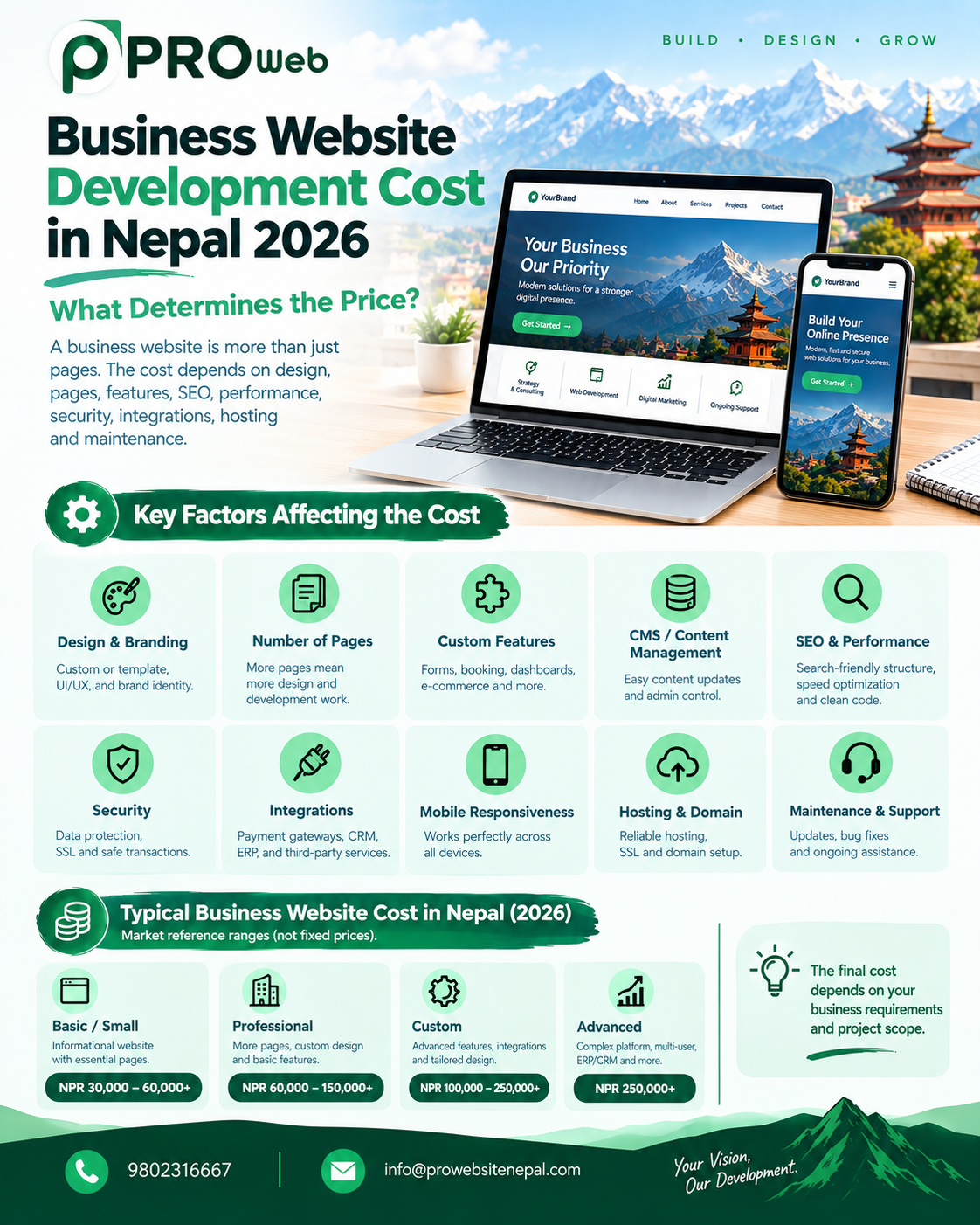
How Much Does Custom Website Development Cost in Nepal?
There is no single fixed price for custom website development.
The cost depends on the scope of the project and the amount of development required.
Important factors include:
Number of pages
Design complexity
Custom functionality
CMS requirements
Admin dashboard
E-commerce features
Payment integrations
API integrations
User accounts
Database complexity
Multilingual functionality
Security requirements
SEO requirements
Hosting infrastructure
Ongoing maintenance
A five-page business website and a custom web application may both technically be “websites,” but their development requirements can be completely different.
For this reason, custom projects are generally better estimated after understanding the actual requirements rather than using one universal price.
What Should You Ask a Custom Website Development Company?
Before starting a project, businesses should ask clear technical and business questions.
About Development
Will the website be custom-developed?
What technology will be used?
Who will own the source code?
Will the architecture support future development?
About SEO
Will technical SEO be implemented during development?
Will the website have proper metadata and structured data?
Will URLs and redirects be planned properly?
About Performance
How will website speed be tested?
Will images and scripts be optimized?
Will mobile performance be considered?
About Security
How will user information be protected?
How will authentication be handled?
Are backups included?
How will security updates be managed?
About Ownership
Will the business own the domain?
Will the business have hosting access?
Will source code be provided?
Will the company have access to the CMS and database?
About Support
What happens after launch?
Is maintenance available?
How are future feature requests handled?
What happens if the business changes development providers?
Website Ownership and Source Code
Ownership should be discussed before development begins.
A business should understand who controls:
Domain
Hosting account
Source code
Database
CMS
Design files
Website content
Third-party accounts
Analytics accounts
Clear ownership arrangements can prevent unnecessary problems later.
Security in Custom Website Development
Security should be considered throughout development rather than only after a website has been attacked.
Depending on the project, security practices can include:
Secure authentication
Password hashing
Authorization
Input validation
CSRF protection
SQL injection prevention
Secure file uploads
Access control
HTTPS
Secure API authentication
Database protection
Regular backups
Server security
The exact security architecture should depend on the type of website and the sensitivity of its data.
Scalability and Future Growth
A website should not necessarily be built only for today's requirements.
A growing business may later need:
More pages
More users
More products
New integrations
Mobile applications
Customer accounts
Advanced analytics
New payment methods
Additional languages
Internal dashboards
Planning for future requirements can reduce the need to completely rebuild the website when the business grows.
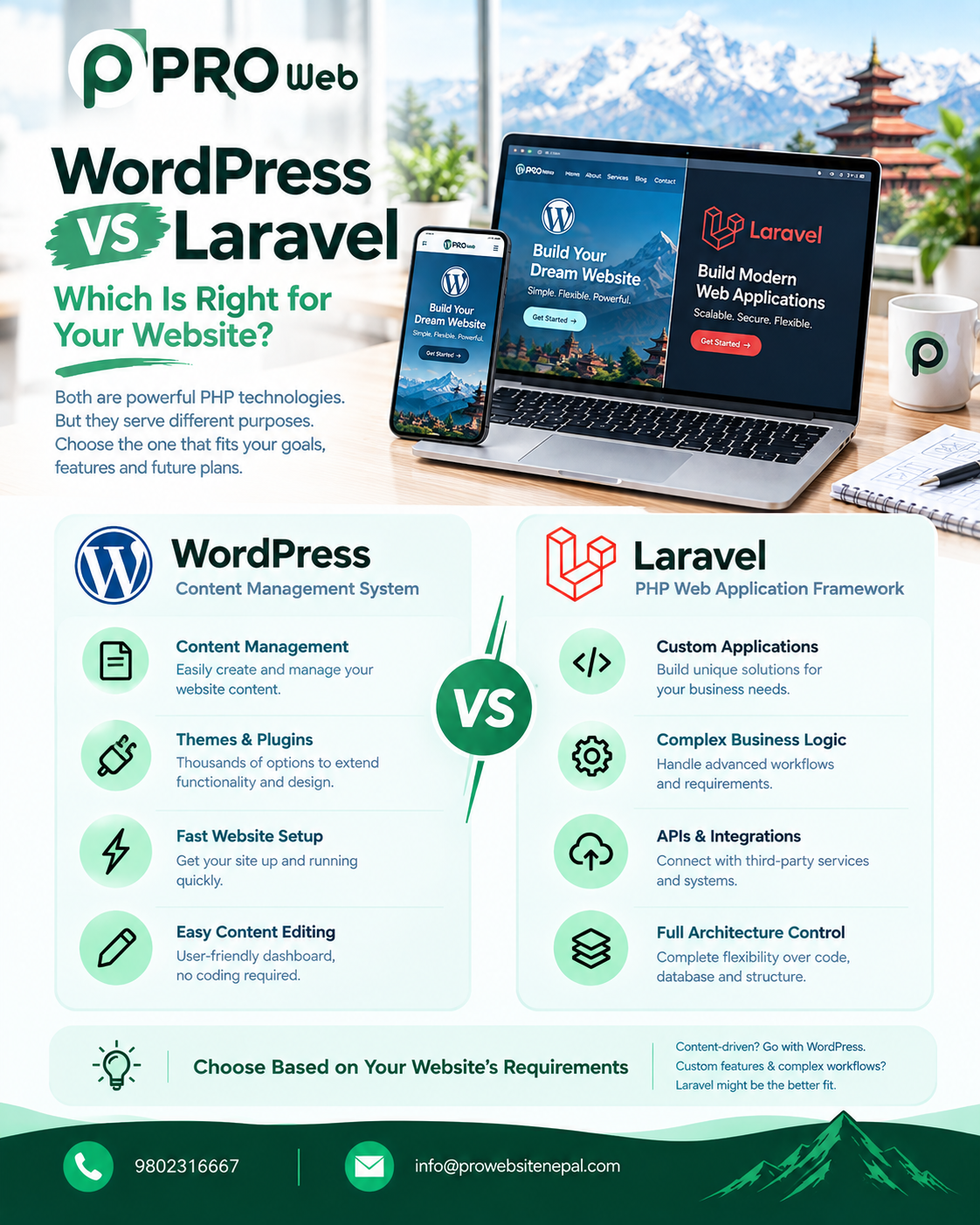
Custom Website Development with Laravel
Laravel is one example of a framework that can be used for custom web applications and websites requiring server-side functionality.
It provides tools for areas such as:
Routing
Authentication
Database interaction
Validation
Sessions
APIs
Queues
Notifications
Authorization
Application structure
The right technology should depend on the requirements of the project rather than using one framework for every website.
Custom Website Development with Modern Frontend Technologies
Modern projects can also use frontend technologies such as React or Next.js depending on their requirements.
These technologies can be useful for projects requiring highly interactive interfaces, application-like experiences, or specialized frontend architectures.
Traditional server-rendered applications can also be highly effective when they are the appropriate solution.
The technology should serve the project rather than becoming the project's objective.
When Should a Business Choose Custom Development?
Custom development may be worth considering when a business requires:
Unique functionality
Advanced integrations
Specialized workflows
Strong control over the code
Custom administration
Complex databases
High scalability
Specific performance requirements
Advanced SEO architecture
Unique customer experiences
For a simple website with limited requirements, a ready-made solution may sometimes be sufficient.
The decision should be based on the business's actual requirements rather than choosing custom development simply because it sounds more advanced.
Common Mistakes in Custom Website Development
Custom development itself does not guarantee a successful website.
Some common mistakes include:
Starting Development Without Planning
Writing code before understanding the requirements can result in unnecessary work.
Focusing Only on Appearance
A visually attractive website still needs good usability, performance, SEO, security, and functionality.
Ignoring Mobile Users
Desktop-first development can create usability problems on smaller screens.
Adding Unnecessary Features
More features do not necessarily create a better website.
Ignoring SEO Until Launch
Technical SEO decisions should be considered during architecture and development.
Poor Content Structure
Even technically strong websites need useful, well-organized content.
Not Planning Maintenance
Websites need ongoing updates, monitoring, backups, and improvements.
Failing to Clarify Ownership
Businesses should understand who owns and controls the website before signing off on a project.
Why Professional Website Nepal Focuses on Custom Development
Professional Website Nepal positions its services around fully custom websites and custom CMS solutions rather than relying on generic templates or builders. Its stated approach combines clean core coding with performance, flexibility, security, responsive development, and SEO considerations.
The development approach is designed around the individual project.
This means the website can be planned according to:
Business objectives
Target audience
Brand identity
Required functionality
SEO strategy
Performance requirements
Security requirements
Future growth
The company also provides custom CMS functionality so businesses can manage website content through an administrative interface rather than requiring developers for every basic content update.
The Long-Term Value of a Custom Website
A website should not only be evaluated by how it looks on launch day.
Its long-term value can depend on whether the business can:
Update content easily
Add new features
Improve SEO
Scale functionality
Integrate new systems
Maintain performance
Protect customer information
Control its infrastructure
Adapt to changing customer expectations
A well-planned custom website can become a long-term digital platform rather than a static online brochure.
Final Thoughts
Custom website development in Nepal provides businesses with the opportunity to build digital platforms around their actual requirements instead of adapting their business processes to a generic template.
From custom design and backend functionality to SEO, performance, security, APIs, CMS development, and future scalability, every part of the project can be planned around the intended purpose of the website.
For businesses that only need a basic online presence, a simpler solution may be enough. But when a website needs unique functionality, greater control, advanced integrations, or room for long-term growth, custom development can provide the technical flexibility required.
The most important consideration is not simply whether a website is custom-coded. It is whether the website is properly planned, well developed, secure, maintainable, fast, useful to its users, and aligned with the business's goals.
Frequently Asked Questions
What is custom website development in Nepal?
Custom website development is the process of creating a website specifically around a business's requirements rather than relying entirely on a pre-built theme or generic website structure.
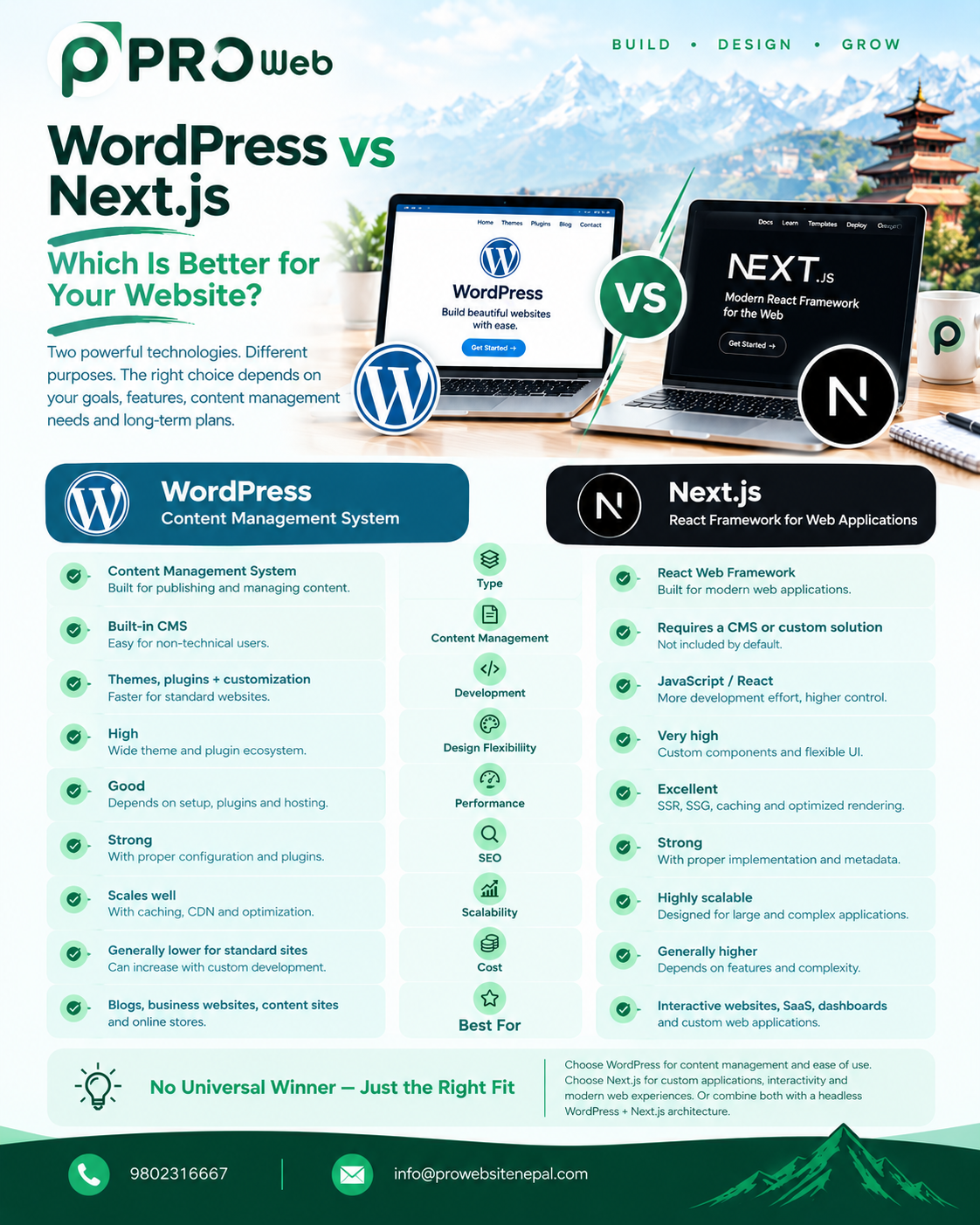
Is custom website development better than WordPress?
There is no universal answer. WordPress can be suitable for many content-driven websites, while custom development can be more appropriate when a business requires specialized functionality, integrations, architecture, or greater technical control.
How long does custom website development take?
The timeline depends on the project's complexity, number of pages, functionality, integrations, content availability, testing requirements, and approval process.
Is custom website development expensive?
Custom development costs vary because projects have different requirements. A simple custom website and a complex web application require very different amounts of design and development work.
Can a custom website be SEO-friendly?
Yes. SEO can be incorporated into the website architecture through proper URLs, semantic HTML, metadata, structured data, mobile responsiveness, performance optimization, internal linking, and other technical practices.
Can I manage a custom website myself?
Yes. A custom CMS or admin panel can be developed so that non-technical users can manage relevant website content.
Can a custom website be expanded later?
Yes. A properly planned architecture can allow new pages, features, integrations, user systems, and other functionality to be added as the business grows.
Who should consider custom website development?
Businesses with unique functionality, specialized workflows, advanced integrations, growing digital requirements, or specific performance and scalability needs may benefit from custom development.
Does Professional Website Nepal build custom websites?
Yes. Professional Website Nepal states that it specializes in fully custom websites and custom CMS solutions developed using clean core coding, with attention to performance, flexibility, security, responsive design, and SEO.