Website Design Company in Nepal: Complete Guide
A website is often the first place where potential customers learn about a business. Before someone calls, visits an office, requests a quotation, or purchases a product, they may first visit the company’s website.
That makes website design much more than choosing colors, fonts, images, and layouts.
A professionally designed website should communicate what a business does, create confidence, make information easy to find, work smoothly on different devices, and guide visitors toward useful actions.
For businesses in Nepal, having a well-designed website can be particularly important as customers increasingly discover companies, services, restaurants, hotels, educational institutions, organizations, and products online.
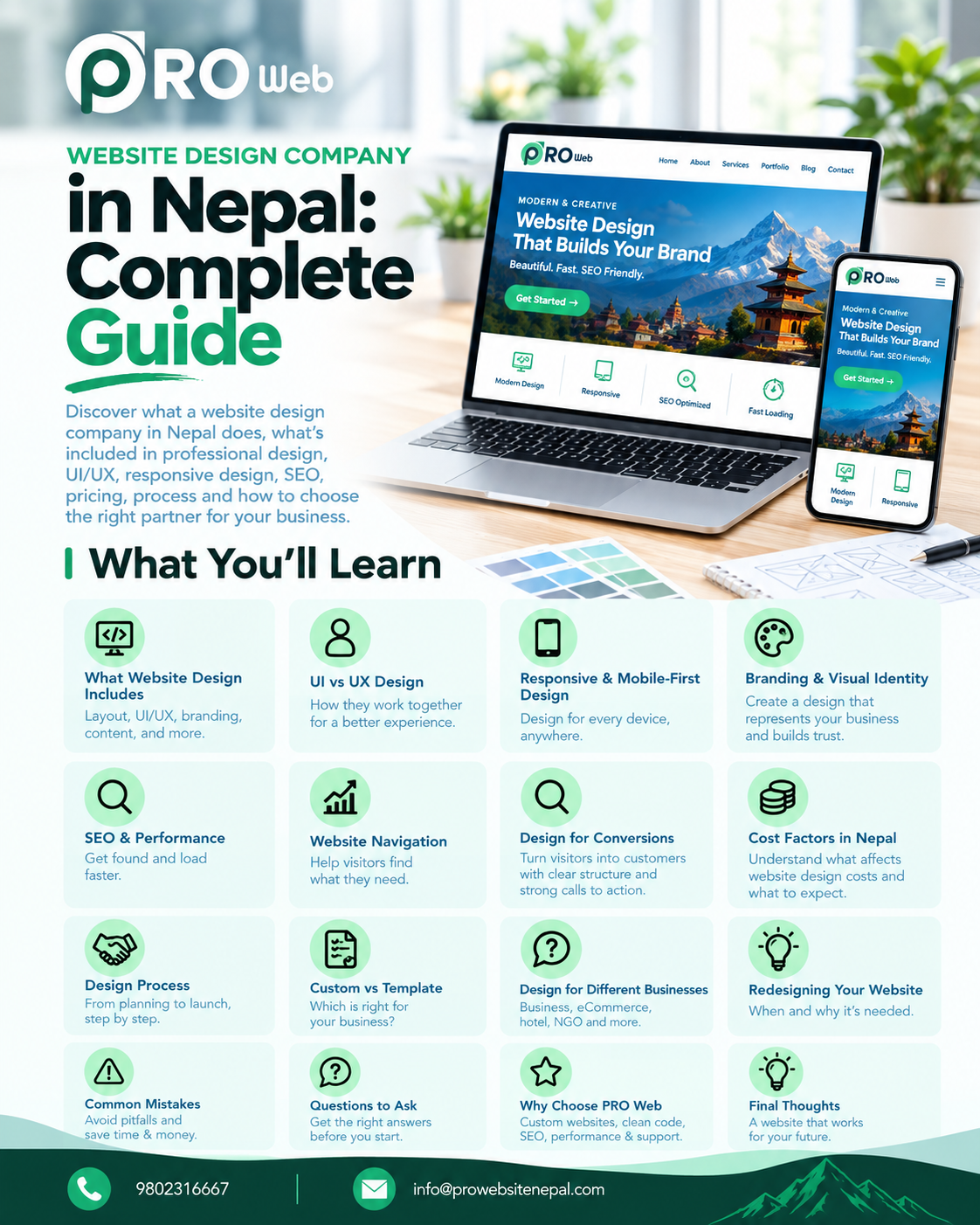
This complete guide explains what a website design company in Nepal does, what professional website design includes, how UI and UX work together, why responsive design matters, how design affects SEO and performance, what the website design process looks like, what affects the cost, and what businesses should consider before starting a website project.
What Is Website Design?
Website design is the process of planning and creating the visual and interactive experience of a website.
It includes much more than making a website look attractive.
A website designer considers:
Layout
Typography
Colors
Images
Branding
Navigation
Content hierarchy
Buttons
Forms
User experience
Mobile responsiveness
Accessibility
Page structure
Calls to action
Visual consistency
The goal is to create a website that is visually professional while also being easy to understand and use.
For example, a restaurant website should make it easy to discover the menu, location, opening hours, reservation options, and contact information.
A software company may need to communicate its services, products, features, case studies, and contact options.
An eCommerce website needs to make browsing, product discovery, checkout, and payment as simple as possible.
Therefore, good website design begins with understanding the business and its users rather than simply choosing a visual style.
What Does a Website Design Company in Nepal Do?
A website design company helps businesses plan and create their online presence.
Depending on the company and project, services may include:
Website strategy
UI design
UX design
Wireframing
Prototyping
Responsive design
Mobile-first design
Branding integration
Website development
SEO-friendly structure
Landing page design
eCommerce design
Website redesign
Performance optimization
Website maintenance
Some companies handle only design, while others provide complete design and development services.
For example, a typical full-service workflow may move from requirements and information architecture to UI/UX design, development, SEO implementation, testing, and launch. This kind of combined approach is common among Nepal-based agencies.
Why Website Design Matters for Businesses in Nepal
A website represents a business online.
When visitors arrive at a poorly structured website, they may struggle to understand:
What the company offers
Who the company serves
Why they should trust it
How to contact the company
Where to find important information
Professional design addresses these problems through clear structure and communication.
1. Creates a professional first impression
Your website can influence how visitors perceive your business.
A clean layout, consistent branding, readable content, high-quality imagery, and clear navigation can make a business appear organized and professional.
2. Builds trust
Trust is especially important when customers are considering an unfamiliar company.
A professional website can provide:
Company information
Contact details
Testimonials
Portfolio
Certifications
Client information
Business location
Service details
Frequently asked questions
3. Makes information easier to understand
Good design organizes information into logical sections.
Visitors should not have to search through multiple pages to understand what your business does.
4. Improves usability
A beautiful website that is difficult to use is still a poor website.
Design should make common actions obvious.
5. Supports business goals
A website may exist to generate:
Leads
Phone calls
Messages
Bookings
Product sales
Applications
Donations
Store visits
Brand awareness
Design should support the specific objective of the website.
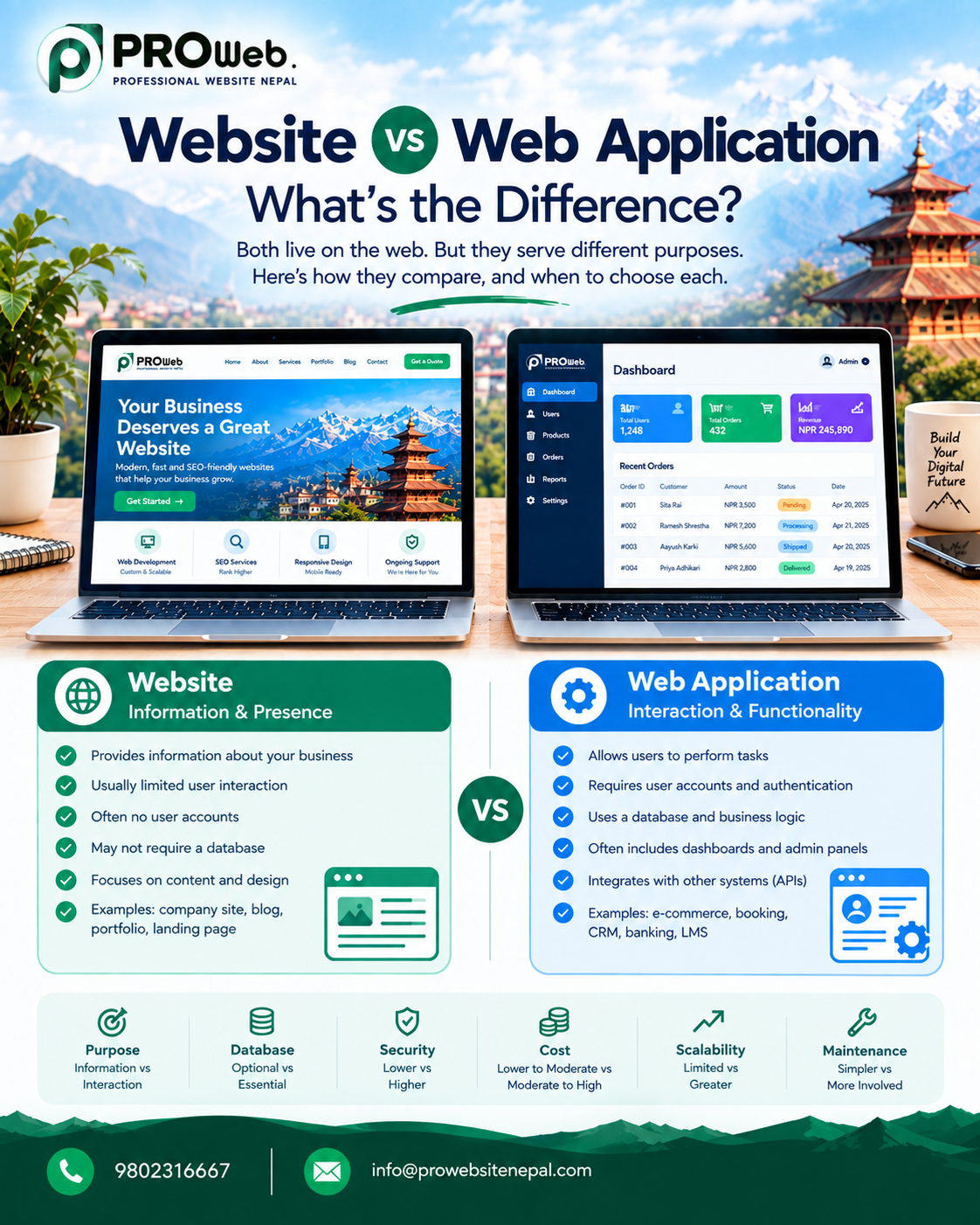
Website Design vs Website Development
Website design and website development are connected, but they are not the same thing.
Website Design
Design focuses primarily on how the website looks and how users interact with it.
It includes:
Layout
Typography
Colors
User interface
User experience
Navigation
Responsive layouts
Visual hierarchy
Website Development
Development turns the design into a functioning website.
It can include:
HTML
CSS
JavaScript
PHP
Laravel
React
Next.js
Databases
APIs
CMS functionality
Authentication
Admin panels
Payment integration
A successful website needs both sides to work together.
A beautiful design without proper development may perform poorly.
Likewise, technically strong development without thoughtful design can result in a confusing user experience.
UI Design and UX Design
Two important terms in modern website design are UI and UX.
What Is UI Design?
UI stands for User Interface.
It focuses on the elements users interact with.
Examples include:
Buttons
Menus
Forms
Cards
Icons
Navigation bars
Images
Typography
Colors
Sliders
Input fields
UI design determines how these elements look and behave.
What Is UX Design?
UX stands for User Experience.
It focuses on the overall experience a visitor has while using the website.
UX considers questions such as:
Can visitors find information easily?
Is the navigation understandable?
Are forms easy to complete?
Is the checkout process simple?
Can mobile users interact comfortably?
Are important actions easy to identify?
A website can have attractive UI but poor UX.
Professional website design combines both.
What Makes a Website Look Professional?
Professional website design is usually the result of many small decisions working together.
Important elements include:
Consistent typography
Fonts should be readable and consistent across the website.
Strong visual hierarchy
Important information should visually stand out from supporting information.
Consistent spacing
Proper spacing makes pages easier to scan.
Appropriate colors
Colors should support the brand rather than distract from the content.
Quality images
Images should be relevant, optimized, and high quality.
Clear buttons
Visitors should understand what happens when they click a button.
Consistent components
Buttons, cards, headings, forms, and menus should follow a consistent design system.
Mobile-First Website Design
A large number of people access websites using smartphones.
That makes mobile design an important consideration when creating a modern website.
Mobile-first design means considering smaller screens early in the design process rather than designing only for desktop and attempting to shrink everything afterward.
A mobile-first website should consider:
Touch-friendly buttons
Readable text
Simple navigation
Appropriate spacing
Optimized images
Fast loading
Easy forms
Mobile-friendly menus
A website should provide a usable experience regardless of whether someone visits from a phone, tablet, laptop, or desktop.
Responsive Website Design
Responsive design allows a website layout to adapt to different screen sizes.
For example, a desktop page may display four cards in one row.
On a tablet, those cards may become two columns.
On a smartphone, they may become a single column.
Responsive design can involve changes to:
Grid layouts
Font sizes
Image sizes
Navigation
Spacing
Columns
Buttons
Forms
Content positioning
The objective is not simply to make everything smaller.
The layout should adapt intelligently to the user's device.
Website Design and Branding
Your website should feel like an extension of your brand.
Branding can include:
Logo
Colors
Typography
Photography style
Icons
Graphics
Tone of communication
Visual patterns
For example, a financial institution may require a more formal visual language, while a creative agency may use a more experimental design.
A website design company should understand the difference between designing something that looks attractive and designing something that represents a specific business.
Designing for the Target Audience
A website should be designed around the people who will use it.
Before beginning the design, a business should consider:
Who are the customers?
What problems do they have?
What information do they need?
What questions do they ask?
What action should they take?
Are they primarily mobile or desktop users?
What makes them trust a company?
For example, a hotel website should prioritize rooms, amenities, location, photos, availability, and booking.
A construction company may need to emphasize projects, services, experience, certifications, and inquiry forms.
An educational institution may prioritize programs, admissions, notices, faculty, facilities, and contact information.
There is no single website design that works equally well for every business.
Website Navigation and Information Architecture
Information architecture is the way information is organized throughout a website.
A website can have excellent visuals but still frustrate visitors if its information is poorly organized.
A typical business website may contain:
Home
About
Services
Products
Portfolio
Blog
FAQs
Contact
The exact structure should depend on the business.
Navigation should help visitors answer:
Where am I?
What can I find here?
Where should I go next?
How do I contact the business?
Simple navigation is usually better than overwhelming visitors with too many choices.
Designing an Effective Homepage
The homepage is often one of the most important pages on a business website.
A typical homepage may contain:
Hero section
Clearly communicate what the business does.
Introduction
Explain the business and its value.
Services
Present the main services or products.
Benefits
Explain why customers should consider the business.
Portfolio or projects
Show evidence of previous work.
Testimonials
Provide social proof.
About section
Introduce the company.
Call to action
Tell visitors what they can do next.
Contact section
Make communication easy.
However, these sections should not be added simply because they are common.
Every section should have a purpose.
Designing Websites for Conversions
A website should not simply attract visitors.
It should help visitors take meaningful actions.
Depending on the business, a conversion could be:
Contacting the company
Calling a phone number
Requesting a quotation
Purchasing a product
Booking a service
Filling out a form
Registering for an event
Downloading information
Design can support conversions through:
Clear calls to action
Strong headlines
Trust signals
Simple forms
Clear pricing information
Relevant testimonials
Easy navigation
Well-structured landing pages
Conversion-focused design should still prioritize clarity rather than aggressively pushing visitors toward actions.
Website Forms
Forms are an important part of many business websites.
Common examples include:
Contact forms
Quote request forms
Registration forms
Booking forms
Newsletter forms
Application forms
A good form should ask for the information actually needed.
Long forms can create unnecessary friction.
For example, if someone only wants to request a quotation, requiring extensive personal information may discourage them from completing the form.
Website Accessibility
Website design should consider users with different abilities and circumstances.
Accessibility can involve:
Sufficient color contrast
Readable typography
Keyboard navigation
Descriptive labels
Alternative text for meaningful images
Clear focus states
Logical heading structures
Accessible forms
Accessibility is not just a technical consideration.
It is part of creating a website that more people can use.
Website Design and SEO
Design and SEO are closely connected.
SEO should not be added after the entire website has already been designed.
Website structure can influence how search engines understand and crawl content.
A design project should consider:
Heading hierarchy
Page structure
Internal linking
URLs
Mobile usability
Image optimization
Page speed
Content hierarchy
Metadata
Structured data where appropriate
Several Nepal-based web agencies currently market SEO-ready or SEO-focused website structures as part of their design/development services.
A visually impressive website that search engines cannot efficiently understand may miss important opportunities.
Website Speed and Design
Website design can affect performance.
Large images, unnecessary animations, excessive scripts, heavy visual effects, and poorly optimized assets can increase loading time.
Performance-conscious design considers:
Image compression
Appropriate image formats
Efficient layouts
Minimal unnecessary animations
Optimized fonts
Efficient code
Browser caching
Responsive images
Fast performance is particularly important for visitors using slower mobile connections.
A good design should therefore balance visual quality with technical efficiency.
Custom Website Design vs Templates
Businesses often have to decide whether to use a template-based approach or create a more customized website.
Template-Based Design
Templates can provide:
Faster setup
Pre-built layouts
Existing components
Lower initial complexity
They can be suitable for some small projects.
However, businesses may have to work within the structure and limitations of the chosen template.
Custom Website Design
Custom design allows a website to be created around:
Brand identity
Business requirements
Target audience
User journey
Performance requirements
SEO structure
Future functionality
Custom design can be especially useful when a business needs a distinctive digital presence or specialized functionality.
Professional Website Nepal focuses on custom websites built around business requirements rather than relying on generic pre-made designs. Its current service positioning emphasizes custom CMS development, clean core coding, performance, SEO, and post-launch support.
Website Design Process in Nepal
A professional website design project generally moves through several stages.
1. Requirement Analysis
The design team learns about:
Business
Target customers
Services
Goals
Competitors
Existing website
Required functionality
2. Website Planning
The team determines:
Pages
Navigation
Content structure
User journeys
Calls to action
3. Wireframing
Wireframes establish the basic structure of pages before detailed visual design.
4. UI Design
The visual appearance is developed.
This includes:
Colors
Fonts
Buttons
Cards
Images
Layout
Components
5. Prototype
Interactive prototypes can help demonstrate how visitors will move through the website.
6. Development
The approved design is converted into a functional website.
7. Content Integration
Text, images, videos, products, services, and other content are added.
8. SEO Implementation
Technical and on-page SEO foundations are implemented.
9. Testing
The website is tested across:
Desktop
Mobile
Tablets
Browsers
Forms
Links
Interactive elements
10. Launch
After final approval and testing, the website is deployed.
11. Post-Launch Support
Maintenance and updates can continue after launch.
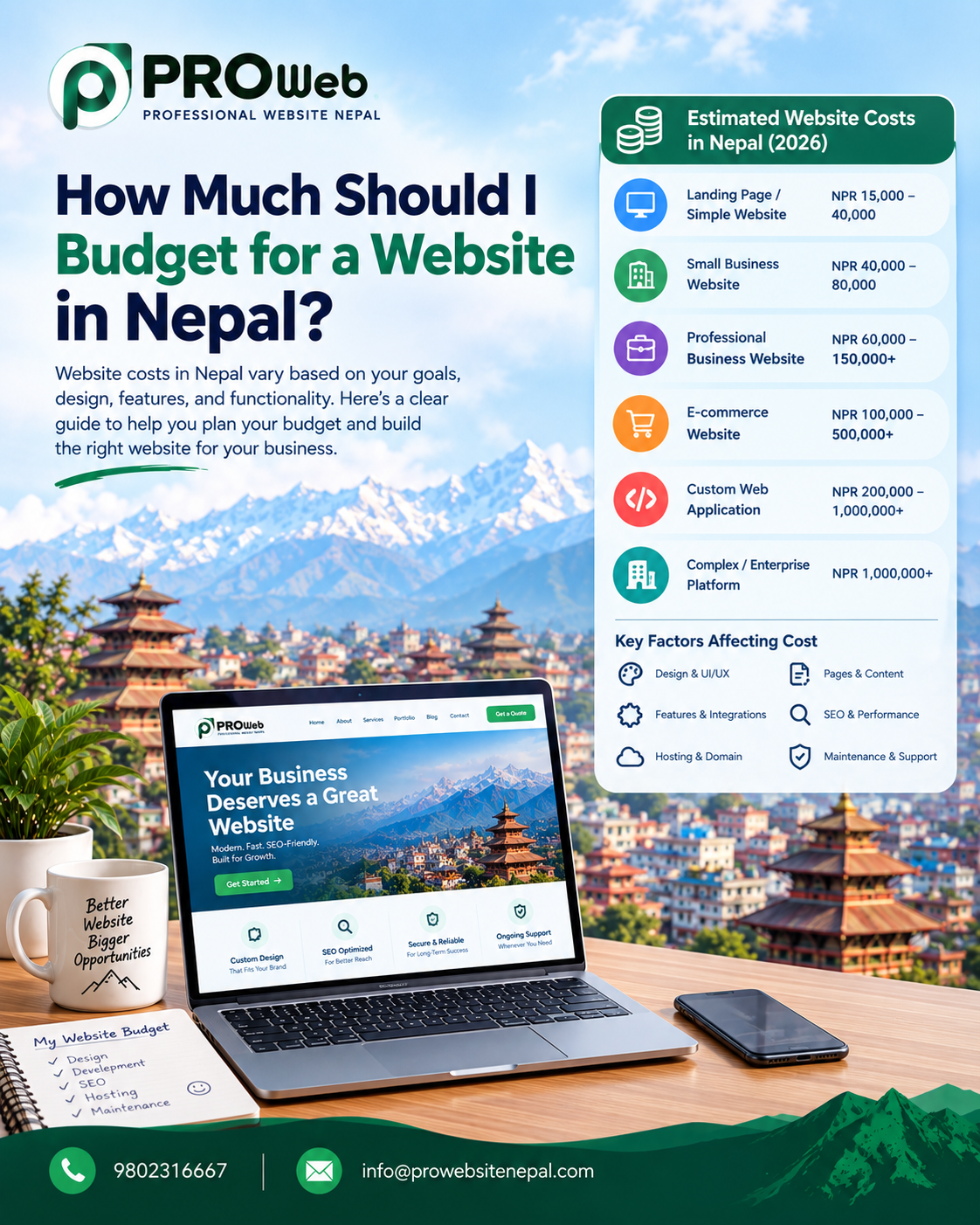
How Much Does Website Design Cost in Nepal?
There is no single fixed price for website design in Nepal.
The final cost depends on the requirements of the project.
Important factors include:
Number of pages
A five-page business website requires a different amount of design work than a large corporate website with dozens of pages.
Customization
A completely custom design generally requires more planning and design work than modifying an existing template.
UI/UX requirements
Projects requiring detailed user journeys, prototypes, user research, or complex interactions may require additional design work.
Functionality
Features such as:
Booking systems
User accounts
Dashboards
Product catalogs
Payment systems
Search
Filtering
Custom forms
can increase project complexity.
Content
Professional copywriting, photography, illustrations, animations, and video production can also affect the project scope.
SEO
SEO planning and implementation may require additional technical and content work.
Integrations
Third-party services and APIs can add development requirements.
Ongoing support
Maintenance, security, updates, hosting, and technical support can be separate ongoing services.
Therefore, businesses should evaluate website pricing based on scope and deliverables, rather than looking only at the initial number.
What Should Be Included in a Website Design Service?
Depending on the project, a professional website design package may include:
Website strategy
Sitemap
Wireframes
UI design
UX planning
Responsive layouts
Brand integration
Homepage design
Internal page design
Contact page
Forms
Calls to action
Mobile design
Basic SEO structure
Development
Testing
Deployment
Businesses should clarify exactly what is included before starting the project.
Website Design for Different Businesses
Different industries require different website structures.
Business Websites
Business websites generally focus on:
Services
Company information
Trust
Portfolio
Testimonials
Contact
Corporate Websites
Corporate websites may require:
Multiple departments
Investor information
Careers
News
Publications
Complex navigation
eCommerce Websites
Online stores require:
Product pages
Categories
Search
Filters
Shopping cart
Checkout
Payment integration
Order management
Hotel Websites
Hotel websites may focus on:
Rooms
Amenities
Gallery
Location
Booking
Contact
Education Websites
Educational websites may include:
Courses
Admissions
Faculty
Notices
Events
Programs
Student resources
NGO Websites
NGO websites often need:
Mission
Programs
Projects
Impact
Reports
Donations
Volunteer information
Portfolio Websites
Creative professionals may prioritize:
Projects
Case studies
Visual presentation
About section
Contact
Website Redesign in Nepal
Not every business needs an entirely new website.
Sometimes an existing website can be redesigned.
A redesign may address:
Outdated visuals
Poor mobile experience
Difficult navigation
Slow performance
Weak conversion paths
Inconsistent branding
Poor content organization
Technical SEO problems
Before redesigning a website, businesses should evaluate the existing site.
Important information such as existing URLs, rankings, backlinks, content, and analytics should be considered during the redesign process.
A redesign should improve the website without unnecessarily destroying useful existing assets.
Common Website Design Mistakes
1. Too much information
A website should not overwhelm visitors with unnecessary text.
2. Poor mobile design
A website that works well only on desktop devices can lose mobile visitors.
3. Weak navigation
Visitors should not have to guess where important information is located.
4. Slow-loading pages
Large images and unnecessary visual effects can hurt performance.
5. Unclear calls to action
Visitors should understand what they can do next.
6. Inconsistent branding
Different pages should feel like parts of the same website.
7. Poor typography
Small or difficult-to-read text makes websites harder to use.
8. Ignoring SEO
SEO should be considered during planning and development.
9. Using too many animations
Animations should improve the experience rather than distract visitors.
10. Designing without the audience
A website should solve user problems rather than simply showcase the designer's creativity.
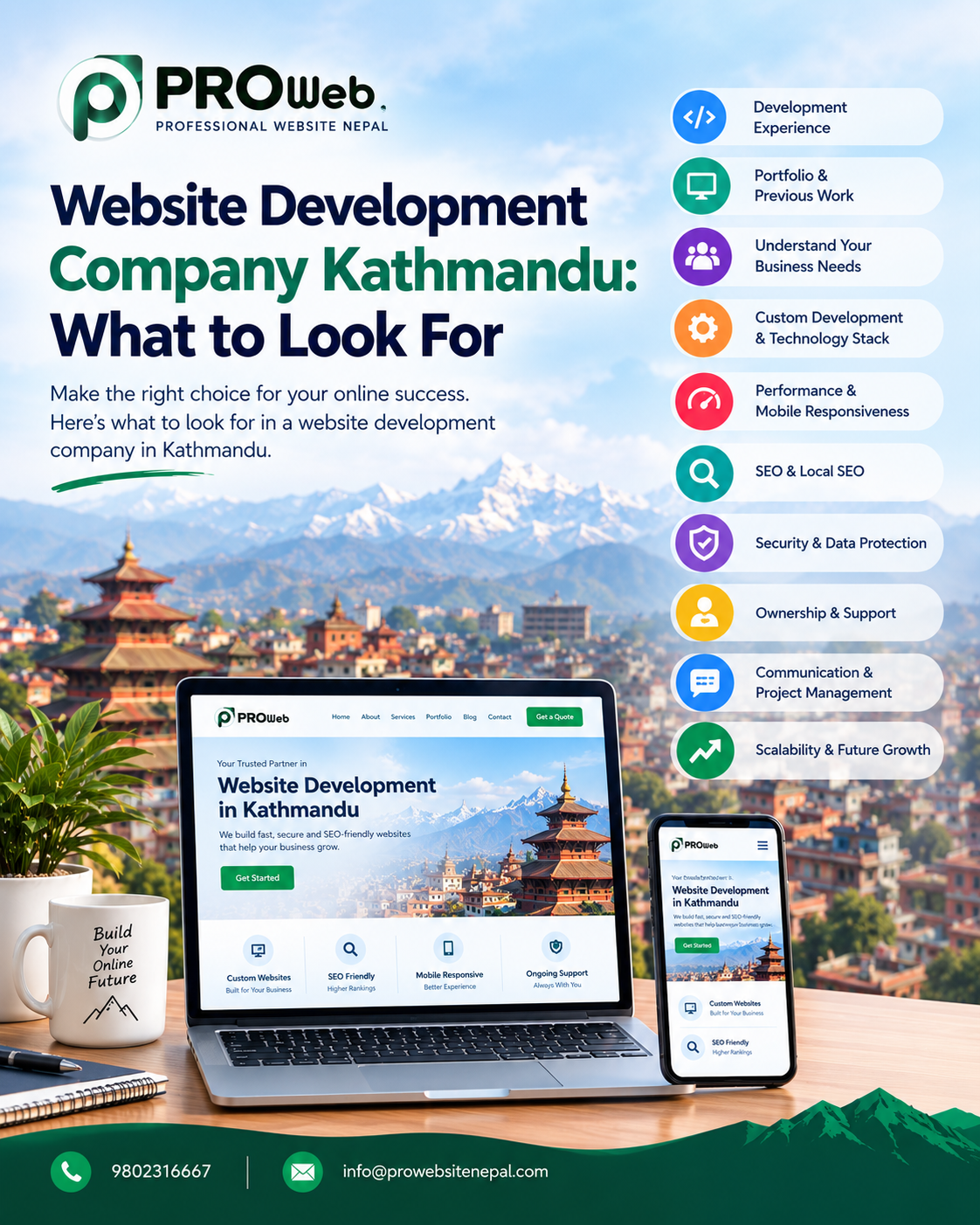
How to Choose a Website Design Company in Nepal
When evaluating a website design company, businesses can examine several practical factors.
Portfolio
Look at previous websites and examine their structure, responsiveness, usability, and visual quality.
Design process
Ask how the company approaches planning, wireframes, UI/UX, revisions, development, testing, and launch.
Technology
Understand what technology will be used and whether it fits the project's requirements.
SEO
Ask how SEO will be handled during design and development.
Mobile responsiveness
Confirm that the website will be designed and tested for mobile devices.
Ownership
Clarify who owns:
Website
Source code
Domain
Hosting account
Design files
Content
Third-party accounts
Support
Understand what happens after the website launches.
Communication
A clear communication process can make a long project much easier to manage.
Questions to Ask a Website Design Company
Before starting a project, businesses can ask:
Do you create custom website designs?
How do you approach UI/UX?
Will the website be mobile responsive?
What technology will you use?
How will SEO be handled?
Who owns the source code?
Will I receive the design files?
Is hosting included?
Do you provide website maintenance?
How many revisions are included?
How is the project timeline determined?
What happens if additional functionality is required?
How will the website be tested?
Can the website be expanded later?
What happens after launch?
Clear answers to these questions can help businesses understand what they are actually purchasing.
Why Professional Website Nepal Focuses on Custom Websites
Professional Website Nepal approaches website creation as a complete digital solution rather than simply producing a visual page.
The company focuses on custom websites built around individual business requirements.
Its current development approach emphasizes:
Custom CMS development
Clean core coding
Responsive UI/UX
SEO implementation
Performance
Security
Scalability
Testing
Ongoing support
The company's stated process moves through requirement analysis, UI/UX design, custom CMS development, SEO implementation, testing and launch, followed by ongoing support.
This approach gives businesses more control over how their website is structured and how it can evolve as the business grows.
Instead of forcing every business into the same design structure, a custom approach allows the website to be developed around the company's actual goals.
Why a Website Should Be Built for the Future
A website should not only work today.
Businesses change.
They may add:
New services
New products
New employees
New locations
Online payments
Customer accounts
Booking systems
Blogs
Marketing campaigns
Integrations
A scalable website structure makes it easier to introduce these changes later.
This is one reason businesses should consider future requirements before choosing their website architecture.
Website Design Is More Than Appearance
A common misunderstanding is that website design is simply about making a website attractive.
In reality, professional website design connects several different disciplines.
It combines:
Branding + UI + UX + Content + SEO + Performance + Technology + Business Strategy
A visually beautiful website that is confusing to navigate does not solve the user's problem.
A technically powerful website that looks outdated may struggle to communicate trust.
A fast website without useful content may fail to generate meaningful results.
The strongest websites bring these elements together.
Final Thoughts
Choosing a website design company in Nepal is an important decision for businesses that want to build or improve their online presence.
Professional website design should go beyond colors, images, and visual effects.
A successful website should communicate clearly, represent the brand, provide a smooth user experience, work across devices, load efficiently, support SEO, and help visitors take meaningful actions.
Whether you are launching a new business website, redesigning an existing website, building an eCommerce platform, creating a corporate website, or developing a custom digital solution, the design should begin with your business objectives and your users.
For businesses looking for a custom approach, Professional Website Nepal provides website design and development focused on custom solutions, clean coding, responsive design, SEO, performance, security, and long-term flexibility.
The right website is not simply one that looks good.
It is one that works for your business, your customers, and your future growth.
Frequently Asked Questions
What is a website design company in Nepal?
A website design company creates the visual structure, user experience, and interface of websites. Many companies also provide development, SEO, hosting, maintenance, and related digital services.
How much does website design cost in Nepal?
Website design costs vary depending on the number of pages, customization, functionality, UI/UX requirements, content, integrations, SEO requirements, and ongoing support.
How long does website design take?
The timeline depends on the project's scope. A simple business website can require significantly less work than an eCommerce platform or custom web application.
Is responsive design important?
Yes. Responsive design allows websites to provide a usable experience across smartphones, tablets, laptops, and desktop screens.
Should SEO be considered during website design?
Yes. Website structure, content hierarchy, mobile usability, performance, navigation, URLs, and other design-related decisions can affect SEO.
What is the difference between UI and UX?
UI focuses on the interface and visual elements users interact with. UX focuses on the overall experience and how easily users can accomplish their goals.
Should I choose a custom website or template?
It depends on the project. Templates can be suitable for certain requirements, while custom design provides greater control over branding, structure, functionality, and future development.
Can an existing website be redesigned?
Yes. A website can often be redesigned to improve its appearance, mobile experience, navigation, performance, SEO, and conversion paths.
Does Professional Website Nepal build custom websites?
Yes. Professional Website Nepal states that it specializes in fully custom websites and custom CMS solutions using clean core coding, with an emphasis on performance, flexibility, security, SEO, and control.
What should I look for in a website design company?
Consider the company's portfolio, design process, technology, responsive design approach, SEO practices, ownership terms, communication process, pricing structure, development capabilities, and post-launch support.